1A · Introduction to Physiology
Anatomy and physiology get spoken as a pair, but they are distinct. Anatomy comes from Greek roots meaning “the process of cutting up.” It is the science of body structure, and those structures were named and illustrated because cadavers have been dissected for medical learning since the ancient Greeks. Physiology translates to “the study of nature.” It is the science of body function.
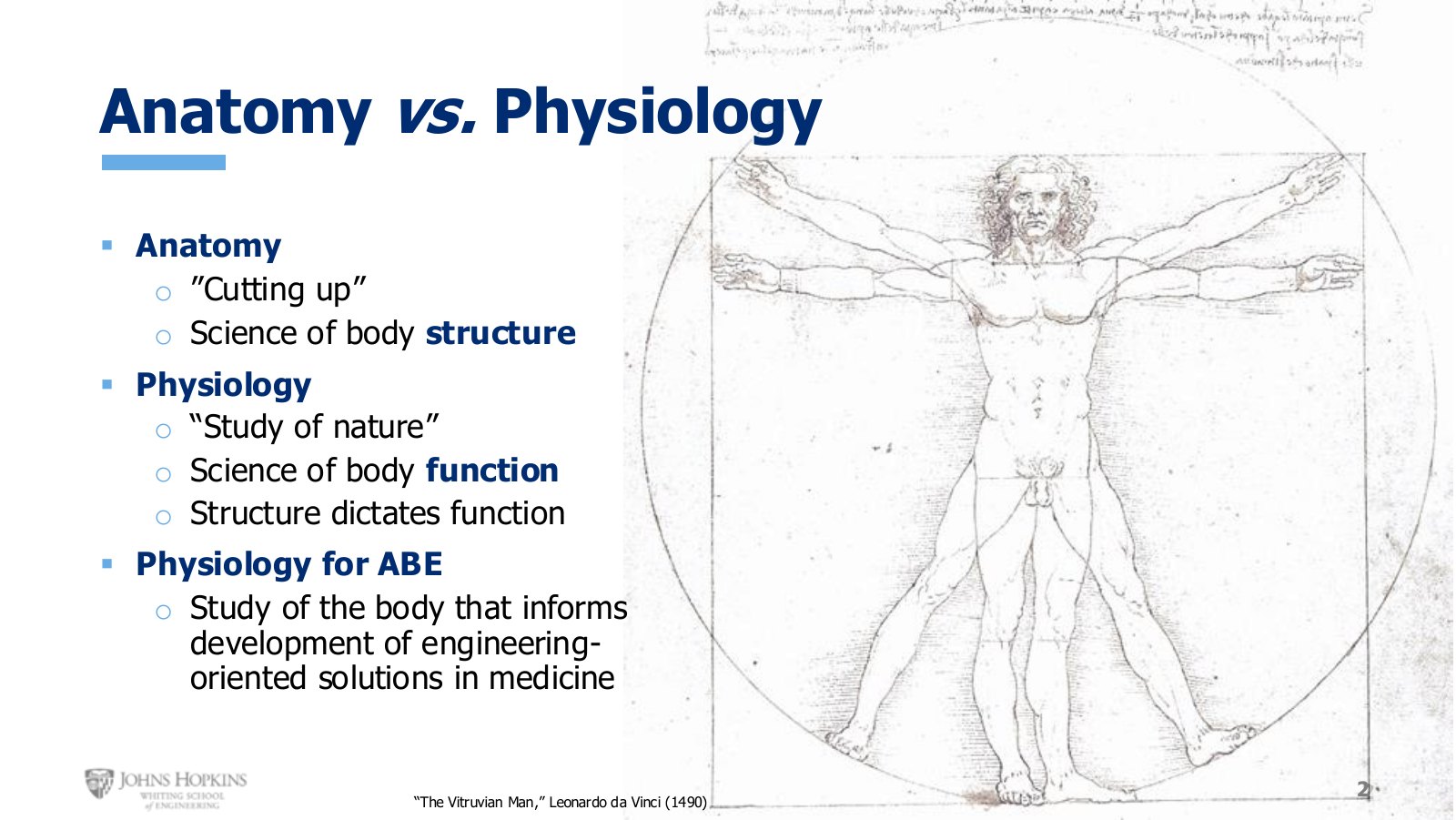
Slide 2. Anatomy against physiology, and why an engineering course studies the body at all.
The two stay tied together for a reason you will meet all semester: the shape and structure of a body part dictate its function. You need a basic grasp of structures before you can discuss how they work.
In a biomedical engineering context, the study of the body is meant to inform your development of engineering-oriented solutions in medicine. You need to understand how a body part functions in order to design an intervention or device that assists or replaces it, and you need enough structural understanding that your designs mimic the body in both form and function.
Levels of body organization
Physiology can be studied at six levels, each built from the one below it.
Chemical. Atoms and molecules, the building blocks. A surprising amount of physiology happens here.
Cellular. Organelles and the cell, the most basic unit of life.
Tissue. A group of cells that work together for a common function.
Organ. A group of tissues with a common function.
Organ system. A group of organs with a common function.
Organism. All systems working together interactively to sustain life.
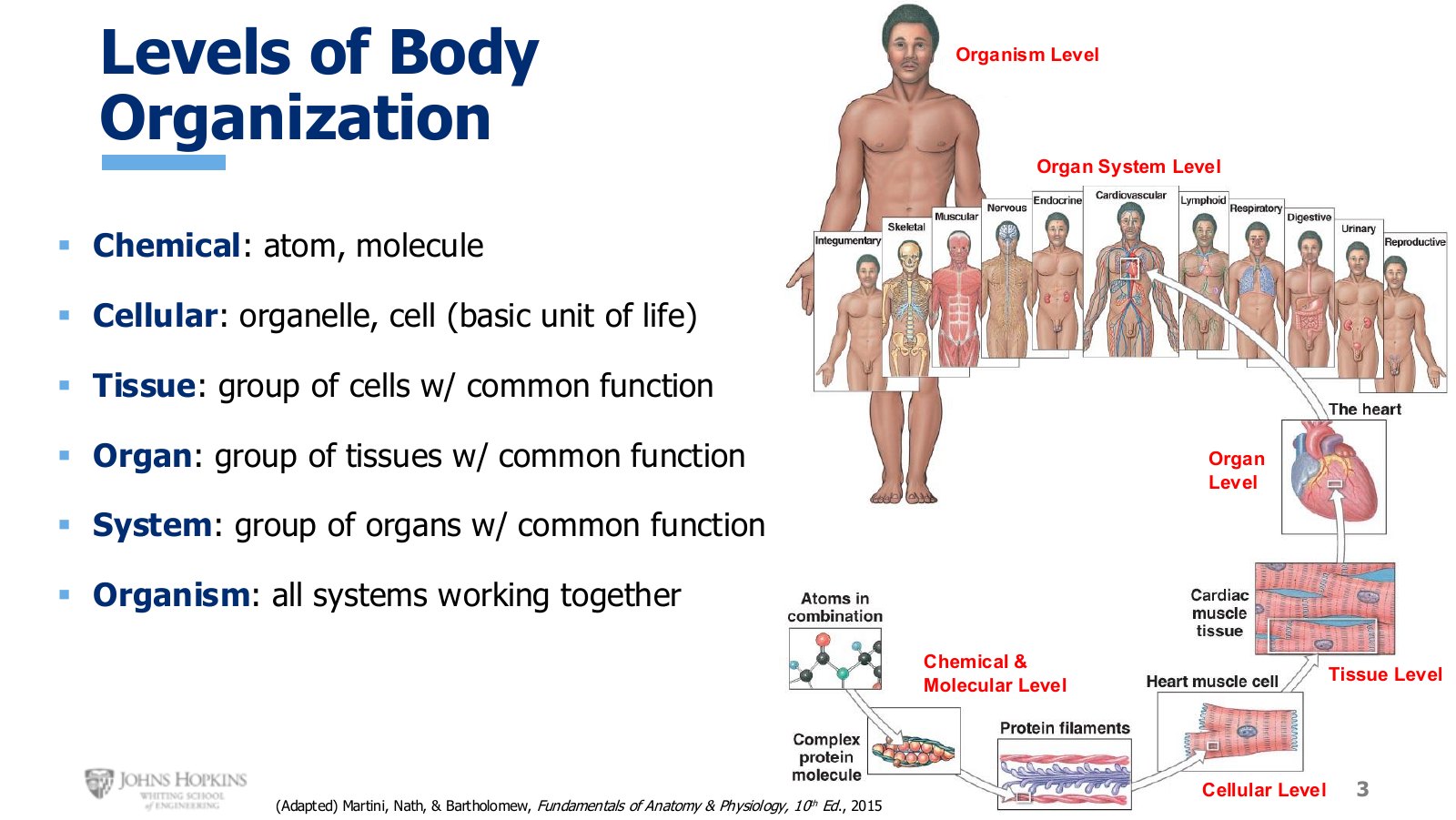
Slide 3. The six levels of organization, drawn as a stack. Every topic this semester sits somewhere on this ladder.
The body’s organ systems are the integumentary (skin and associated structures), skeletal, muscular, nervous, endocrine, cardiovascular, lymphatic (fluid management plus immune function), respiratory, digestive, urinary, and reproductive systems.
The semester will not march through these levels one at a time. It organizes around body systems, then analyzes each system using vocabulary from every level at once. The systems covered are muscular, cardiovascular, and respiratory.
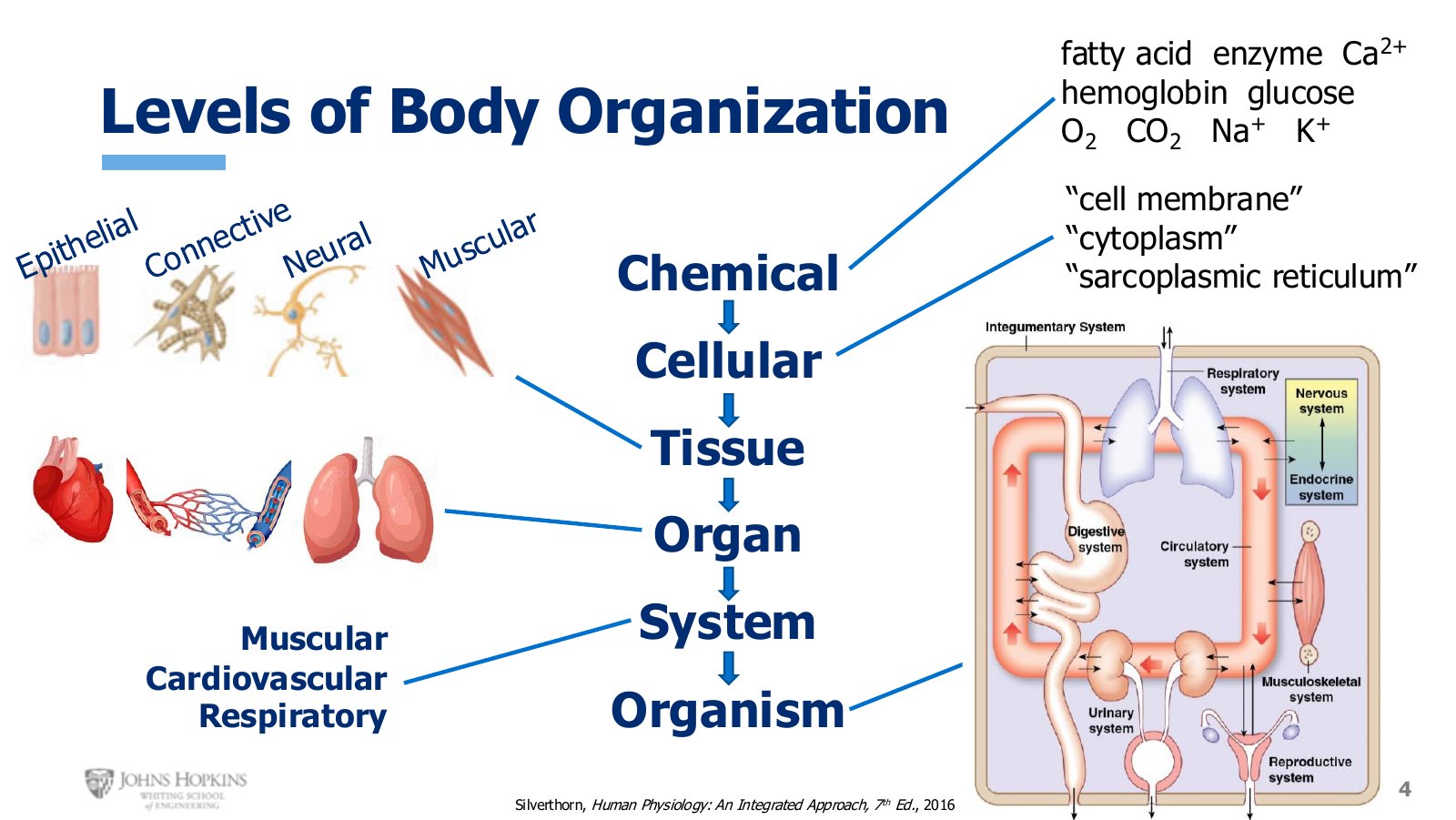
Slide 4. The same ladder, populated with the specific molecules, structures, and systems this course keeps returning to.
Chemical-level discussions will involve fatty acids, enzymes, calcium, hemoglobin, glucose, oxygen, carbon dioxide, sodium, and potassium. Cellular-level discussions will involve cell membrane structure, the composition of the cytoplasm, and the sarcoplasmic reticulum, a specialized organelle found in muscle cells.
The four tissue types
There are only four tissue types in the entire body. Every bit of flesh you can pinch, see, or biopsy falls into one or more of these categories.
Muscular tissue contains contractile proteins that let it generate force.
Neural tissue generates electrical signals to process information and communicate across the body. Module 2 covers the fundamental properties of excitable membranes, meaning cell membranes that can generate electrical signals.
Epithelial tissue covers all surfaces, external and internal: skin, the lining of the nose and mouth, the surface of the eyeballs, the outer covering of the lungs, the inner lining of blood vessels.
Connective tissue is the catch-all. If it is not muscular, neural, or epithelial, it gets lumped here. The packing peanuts of the body.
Homeostasis
Homeostasis translates to “the same, standing still.” It is the dynamic process of maintaining a stable internal environment against disturbances arriving from both the outside world and our own internal processes. Stable blood pH, core temperature, blood pressure, glucose, calcium, sodium, potassium, water volume.
The disturbances never stop. A cold day pulls body heat out to the environment. Eating changes the nutrient content of blood. Exercise raises core temperature, drops muscle pH through metabolic acid production, and drains body water through sweat. Even breathing and using oxygen perturbs pH and generates free radicals. Everything we do threatens homeostasis, which is why it truly is a dynamic process.
Homeostasis is defended by negative feedback systems, which reverse a departure and return the variable to its acceptable range. Spend too long outside that narrow range and you die. Blood calcium too low, you die. Body temperature too high, you die. Blood glucose too low, you die.
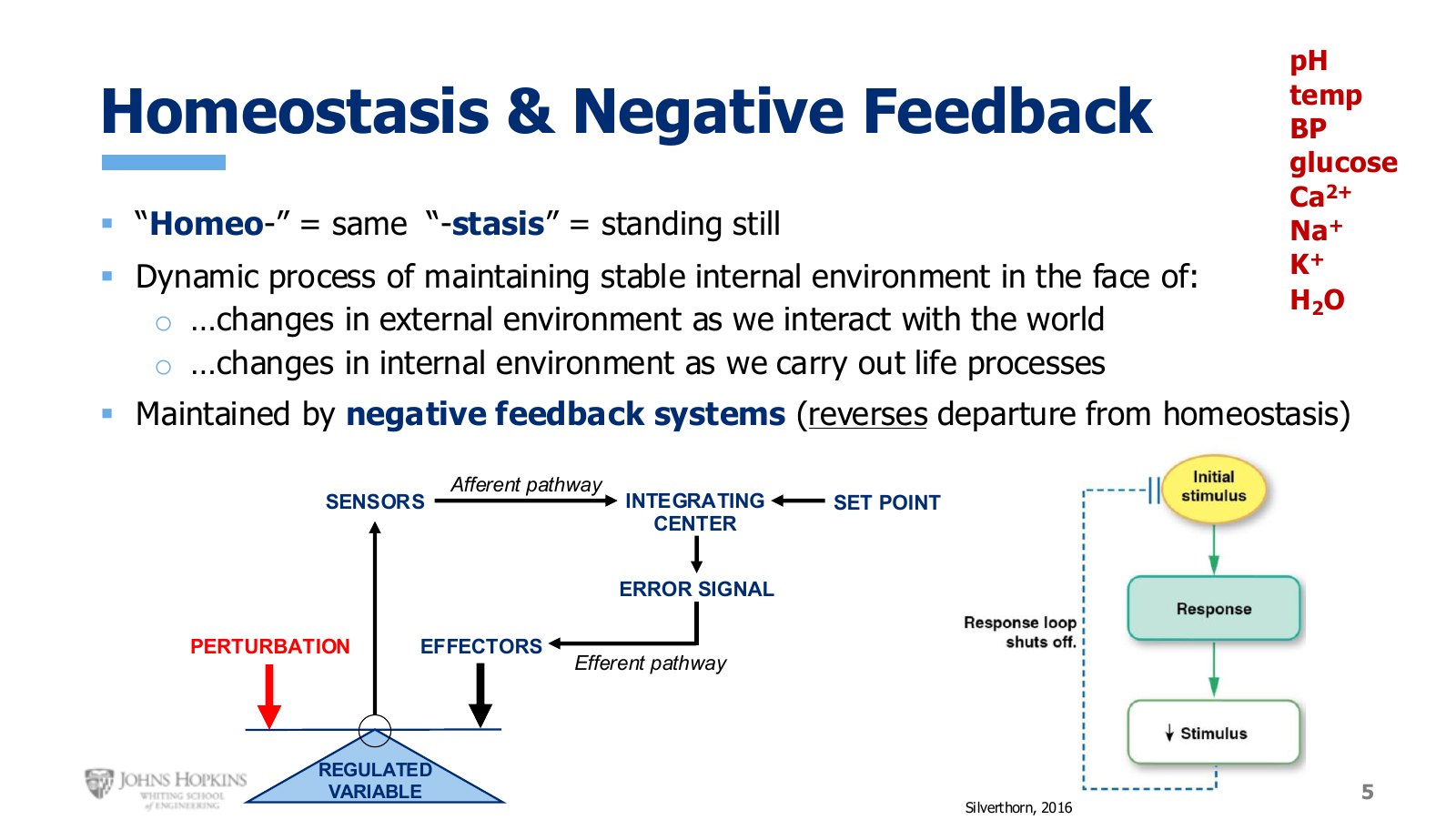
Slide 5. The negative feedback schematic. This diagram returns repeatedly through the semester, so learn to read it fluently.
Reading the schematic: the regulated variable sits on a seesaw representing systemic balance. A perturbation pushes down on one end. Sensors monitor the variable and detect the departure, then send a message along an afferent pathway, meaning a pathway heading toward the region of interest, to an integrating center.
The integrating center also receives the set point for that variable. It compares the incoming sensor information against the set point and generates an error signal. That signal travels out along efferent pathways, meaning away from the region of interest, to the effectors, the mechanisms that fix the problem and restore balance.
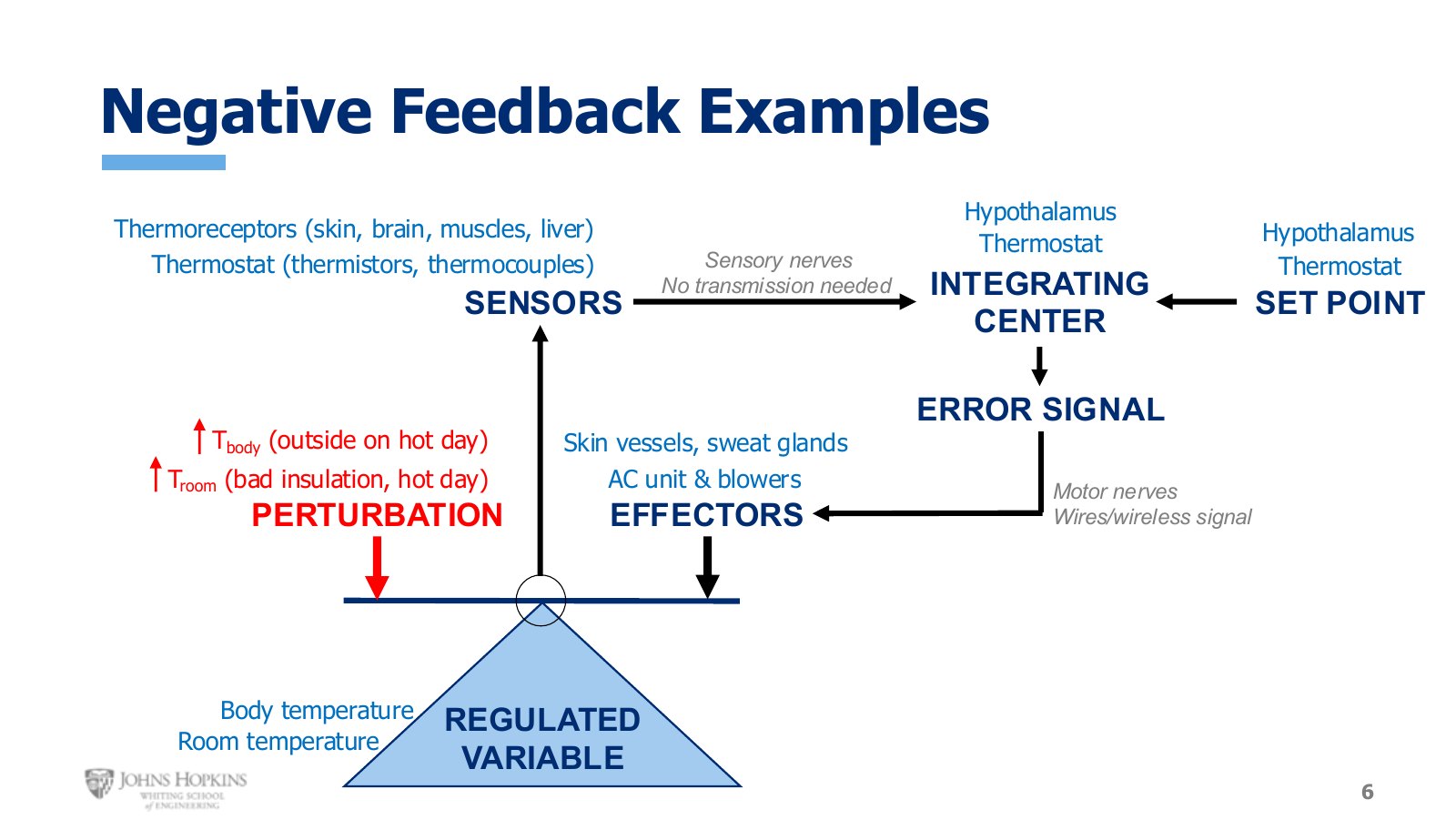
Slide 6. Two worked negative feedback loops side by side. Room temperature and body temperature use identical logic with different hardware.
Air conditioning. Room temperature is the regulated variable, sensed by a wall thermostat containing a thermistor or thermocouple. Bad insulation and south-facing windows on a hot day push room temperature up. No transmission is needed because the integrating circuitry and the saved set point usually live in the thermostat unit. Comparing live temperature against the set point generates an error signal, carried by wires or wirelessly to the effectors, the outside AC unit and the duct blowers. Cold air circulates into the room and thermal balance returns.
Body temperature. Body temperature is the regulated variable, sensed by thermoreceptors in skin, brain, muscles, and liver. A hot day raises skin and core temperature. The signal travels via afferent sensory nerves to the preoptic anterior hypothalamus, which is both the body’s temperature regulatory center and the place the set point is determined. The error signal goes out via efferent motor nerves to two effectors: skin blood vessels dilate to bring more blood to the surface, giving off heat convectively and radiatively, and sweat glands begin sweating, contributing evaporative heat loss.
Positive feedback
Positive feedback does the opposite. Instead of reversing a departure from homeostasis, it reinforces and intensifies it. A stimulus elicits a response, the response intensifies the stimulus, which intensifies the response, and so on. It is a series of intensifying iterative cycles.
Because a departure from homeostasis can be deadly, these loops are short-lived and rare. They exist to perform unusual tasks that benefit the body in the moment but would hinder normal function if they lasted too long. Every one of them requires a deliberate external cutoff switch.
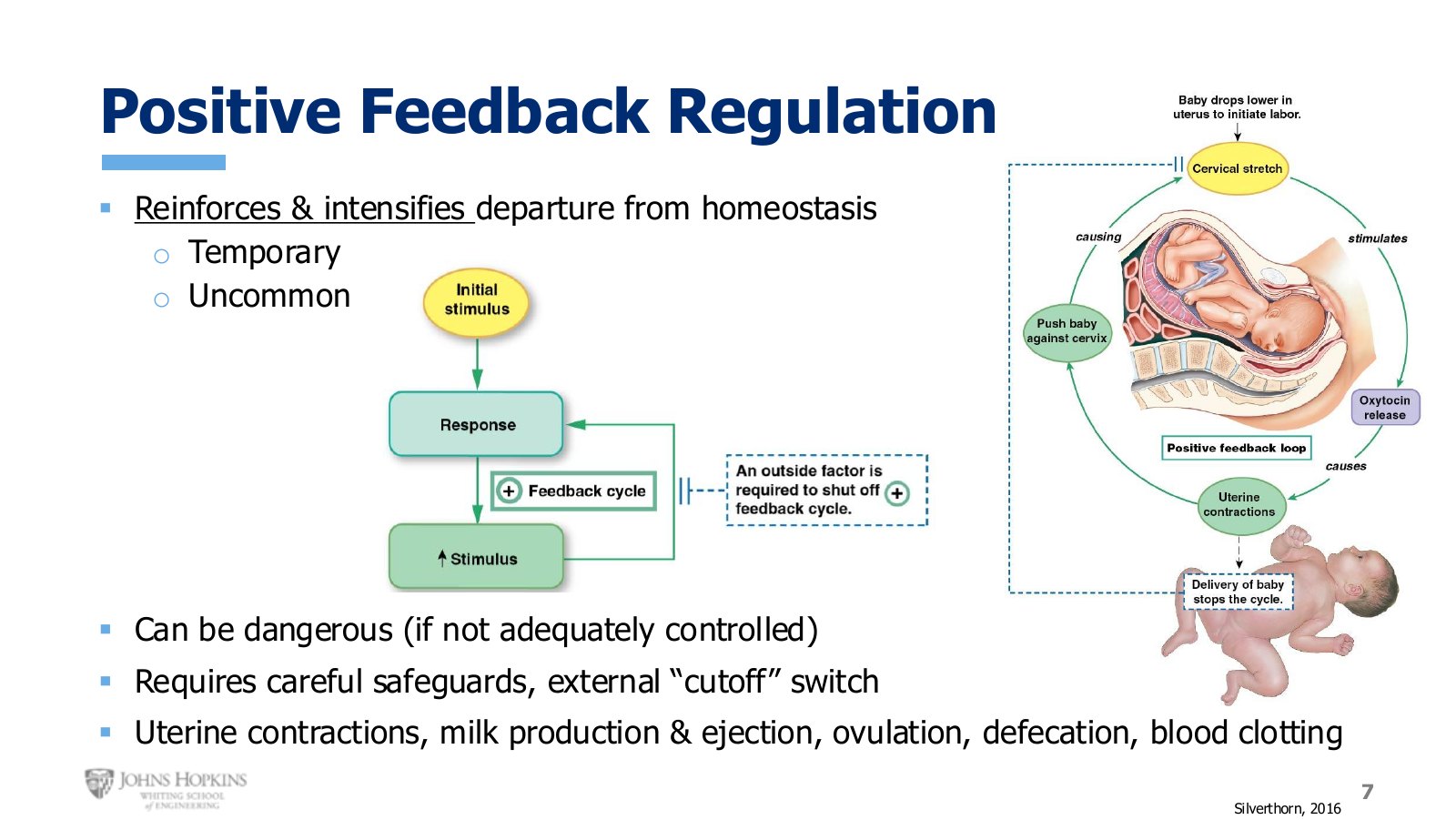
Slide 7. Positive feedback reinforces a departure rather than reversing it, so every loop needs an outside factor to shut it off.
Childbirth. The baby’s head presses down on the cervix, the bottom portion of the uterus where it opens into the vaginal birth canal. Cervical stretch releases oxytocin, which targets uterine muscle and drives stronger, more frequent contractions. Those contractions push the head harder against the cervix. More pressure, more oxytocin, more contractions, more pressure. Delivery of the baby removes the pressure and breaks the cycle.
The full list of positive feedback systems in the body is short: uterine contractions during childbirth, milk production and ejection from mammary glands, ovulation, defecation, and blood clotting. All except blood clotting are covered in Physiology II.
Gradients make the body go round
A gradient is a difference in some characteristic between two regions. A difference in concentration between two regions of a tank is a concentration gradient. A difference in temperature between the inside and outside of your car is a thermal gradient. A difference in pressure across a water bottle wall is a pressure gradient.
Gradients matter because a gradient makes something flow somewhere.
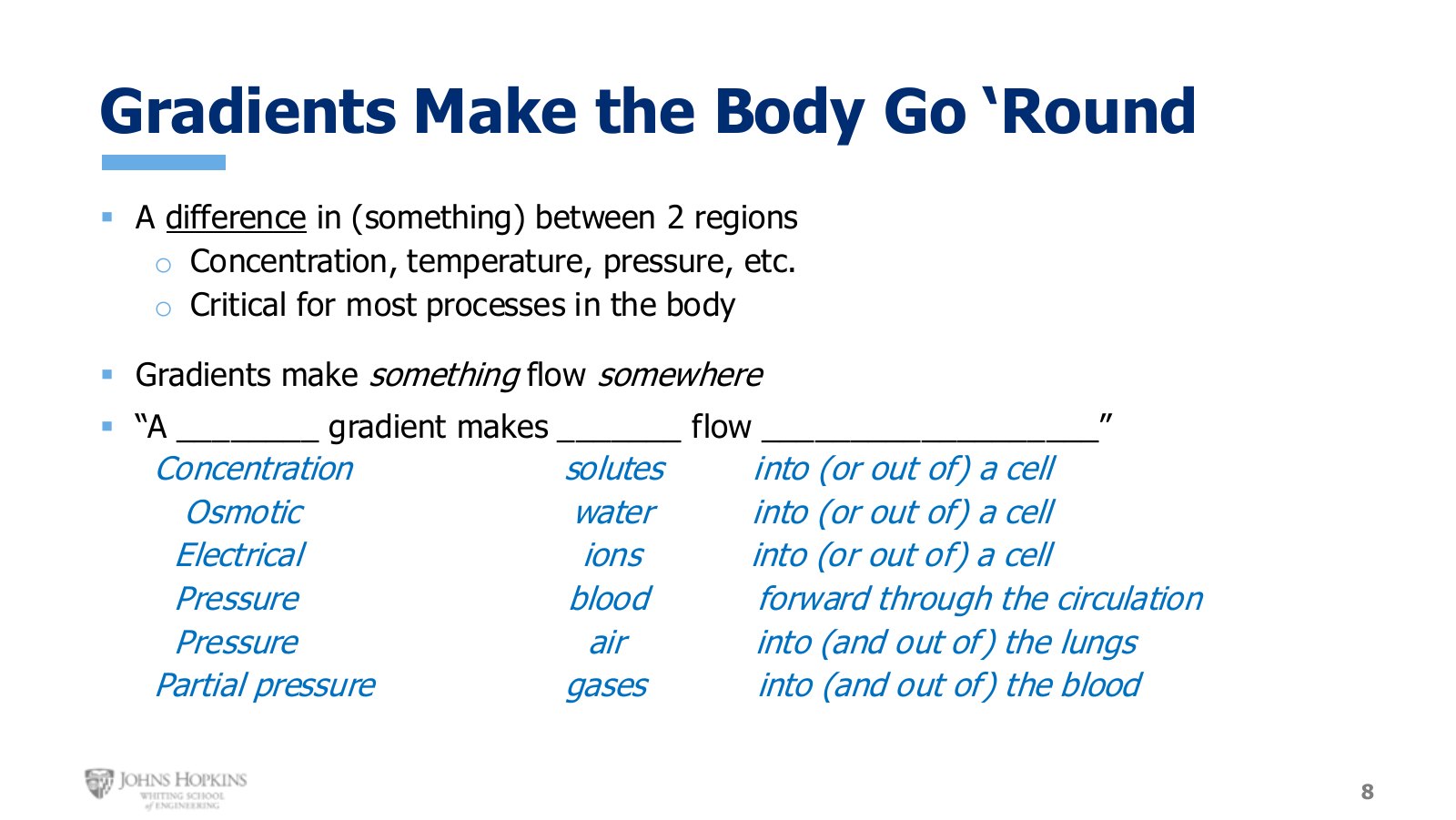
Slide 8. Fill-in-the-blank table: a ______ gradient makes ______ flow ______. Worth memorizing as a set.
A concentration gradient makes solutes flow into or out of a cell.
An osmotic gradient makes water flow into or out of a cell.
An electrical gradient makes ions flow into or out of a cell.
A pressure gradient makes blood flow forward through the circulation, and air flow into and out of the lungs.
A partial pressure gradient makes gases flow into and out of the blood.