1C · Diffusion and Membrane Transport
Separating the extracellular and intracellular compartments would make little sense if they had the same composition. We separate them precisely because their compositions differ, and we want to keep them distinct.
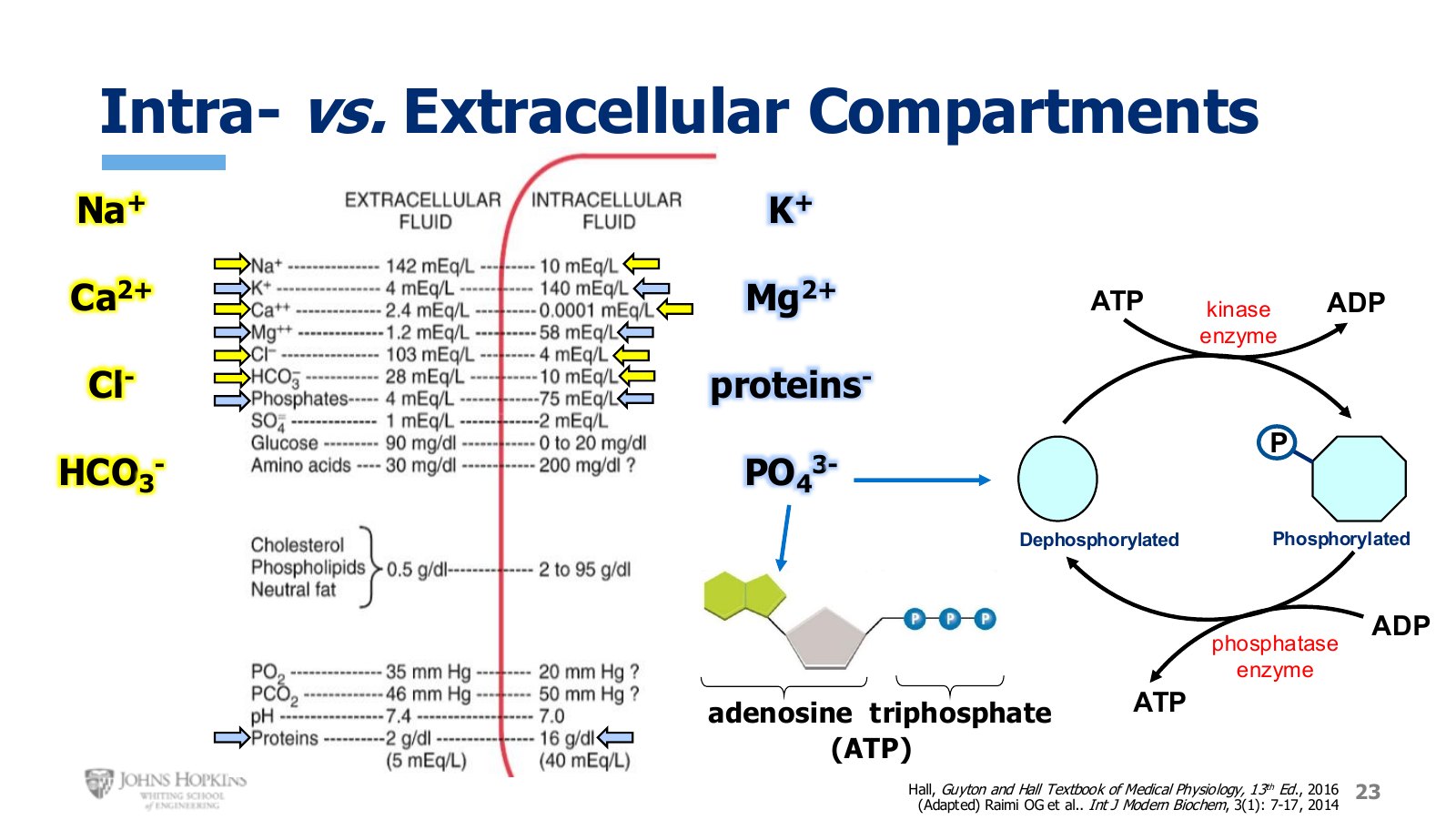
Slide 23. Solute concentrations on either side of the membrane, plus the phosphorylation cycle and the structure of ATP.
Predominating outside the cell. Two cations: sodium, which has a sizable inward gradient the body relies on heavily in neurons and muscle, and calcium, which has a huge inward gradient relied on heavily in the heart. Two anions: chloride and bicarbonate, which get attention later in the semester.
Predominating inside the cell. The pattern mirrors it. One +1 ion, potassium, important in Modules 2 and 6. One +2 ion, magnesium. Two notable anions, both starting with P: proteins and phosphate.
Proteins perform many functions in the cell and also exert a strong negative influence inside it, which matters in Modules 2 and 6. Phosphate ions matter for three reasons. They contribute to that negative influence. They can be attached to or detached from molecules inside the cell, called phosphorylation and dephosphorylation, which instantly changes a molecule’s function, a physiological light switch engaging or disengaging proteins. And phosphate is a component of ATP, adenosine triphosphate.
What diffusion is
Diffusion is the passive movement of a particle from an area of high concentration toward an area of lower concentration. The concentration gradient supplies the driving force. Think of the gradient as potential energy that converts to kinetic energy of movement as soon as diffusion is allowed to proceed.
Because of that, no additional energy input is required, which is why diffusion is a passive process. Unless something external stops it, diffusion continues until concentration equilibrium, where no difference remains.
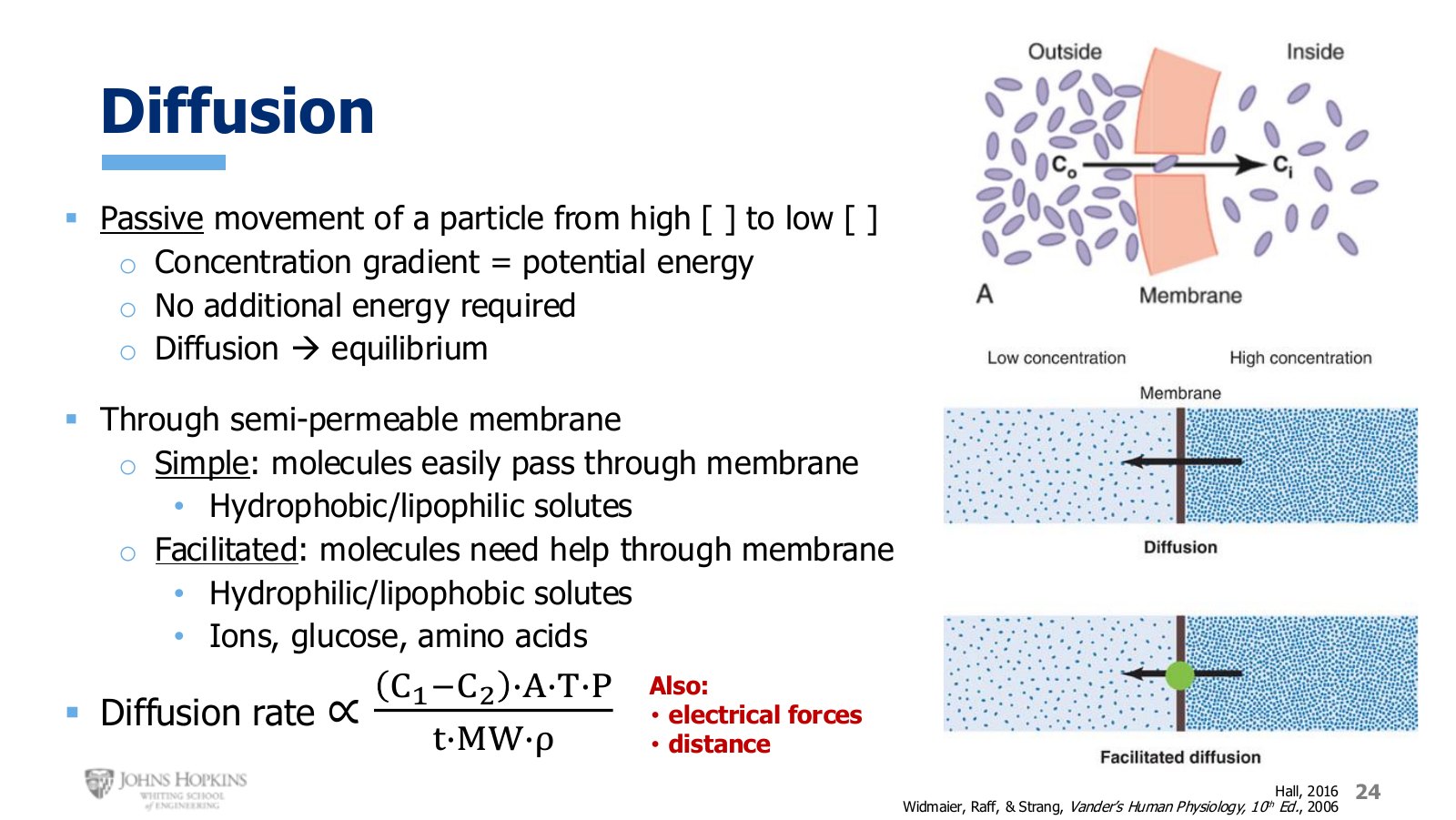
Slide 24. Simple versus facilitated diffusion, with the parameters governing diffusion rate.
Across a semi-permeable membrane, two cases split apart.
Simple diffusion describes molecules that pass easily through the membrane on their own, meaning hydrophobic and lipophilic solutes. Nothing hinders their movement.
Facilitated diffusion describes hydrophilic solutes, which need more than a gradient. They need physical help crossing, supplied by a membrane transport protein.
What sets the diffusion rate
The expression below is not a formal flux equation. It is missing constants, exponents, and square roots. It does give a good picture of which parameters matter and in which direction.
Everything in the numerator is directly proportional: diffusion increases as the factor increases. The magnitude of the concentration gradient, the surface area across which diffusion occurs, the temperature, and the membrane permeability for that particular solute all push the rate up.
Everything in the denominator is inversely proportional: membrane thickness, the size or molecular weight of the solute, and the density of the diffusion medium all push the rate down.
Two more factors sit outside the expression. Electrical forces matter especially for charged ions. Distance matters because longer distances take more time.
Facilitated diffusion and transport proteins
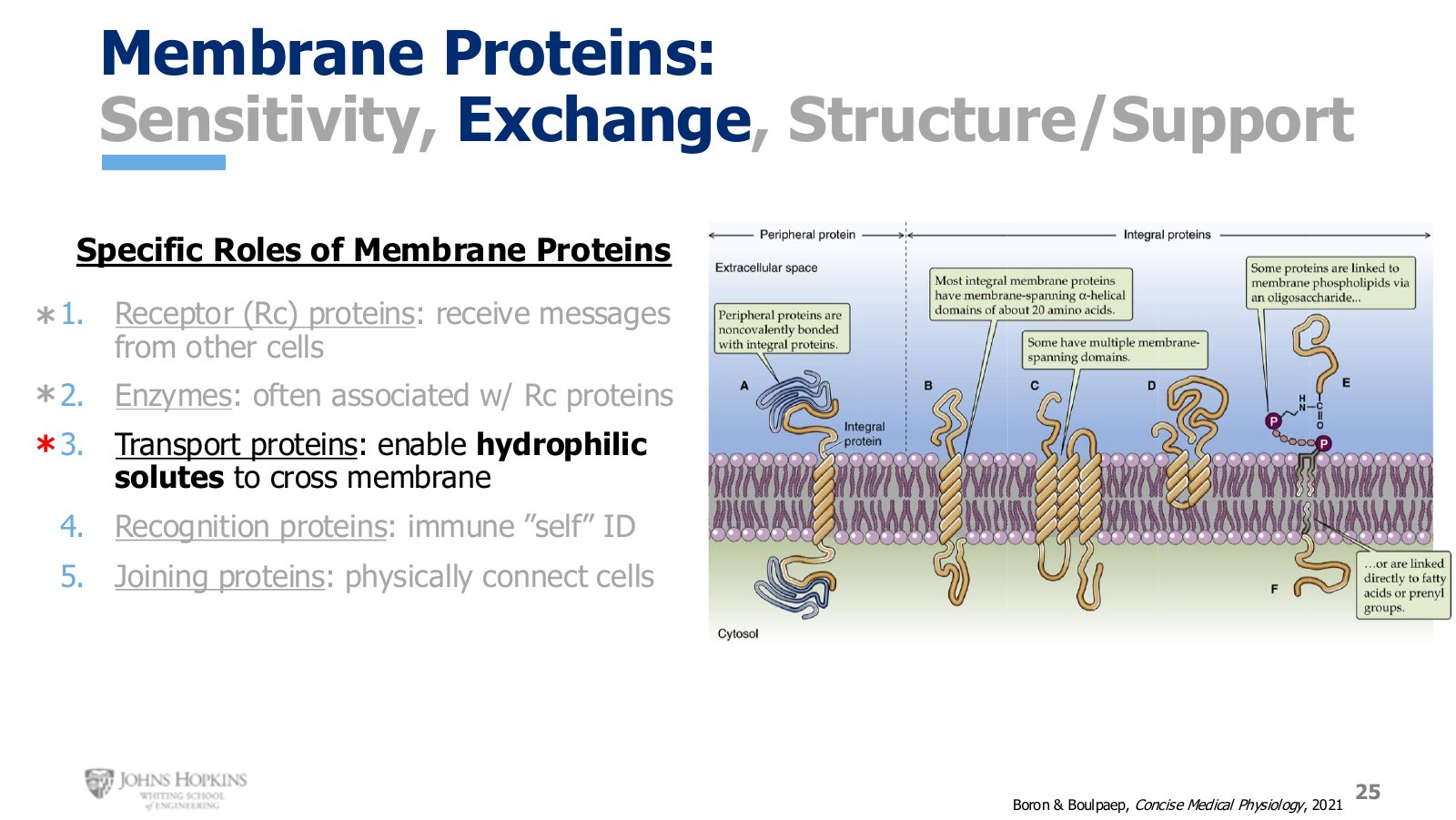
Slide 25. The membrane protein roster a third time. Transport proteins are the ones this lecture is about.
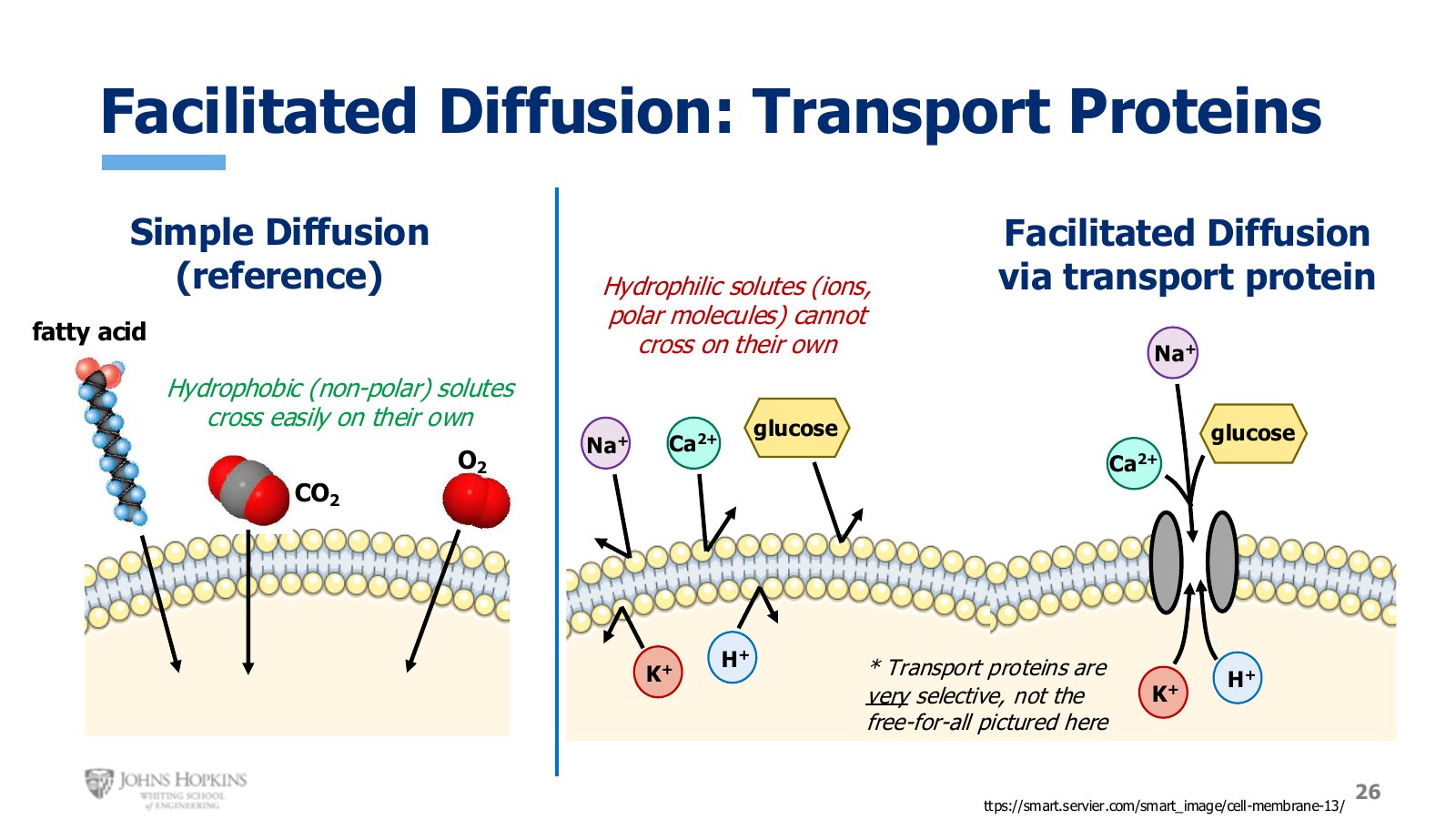
Slide 26. Left, the reference case: hydrophobic solutes cross unaided. Right, hydrophilic solutes require a protein pathway.
Nonpolar hydrophobic solutes like fatty acids, carbon dioxide, and oxygen navigate the nonpolar core without trouble and pass through on their own. Polar molecules and ions can interact easily with the polar phosphate heads, but cannot penetrate the hydrophobic fatty acids in the middle. Their chemistry stops them.
Membrane transport proteins solve this by creating a physical pathway through the membrane, so calcium, sodium, and glucose can enter and potassium and hydrogen can leave. This exchange is vital for survival and happens only because the transport protein is there.
One solute at a time: channels and carriers
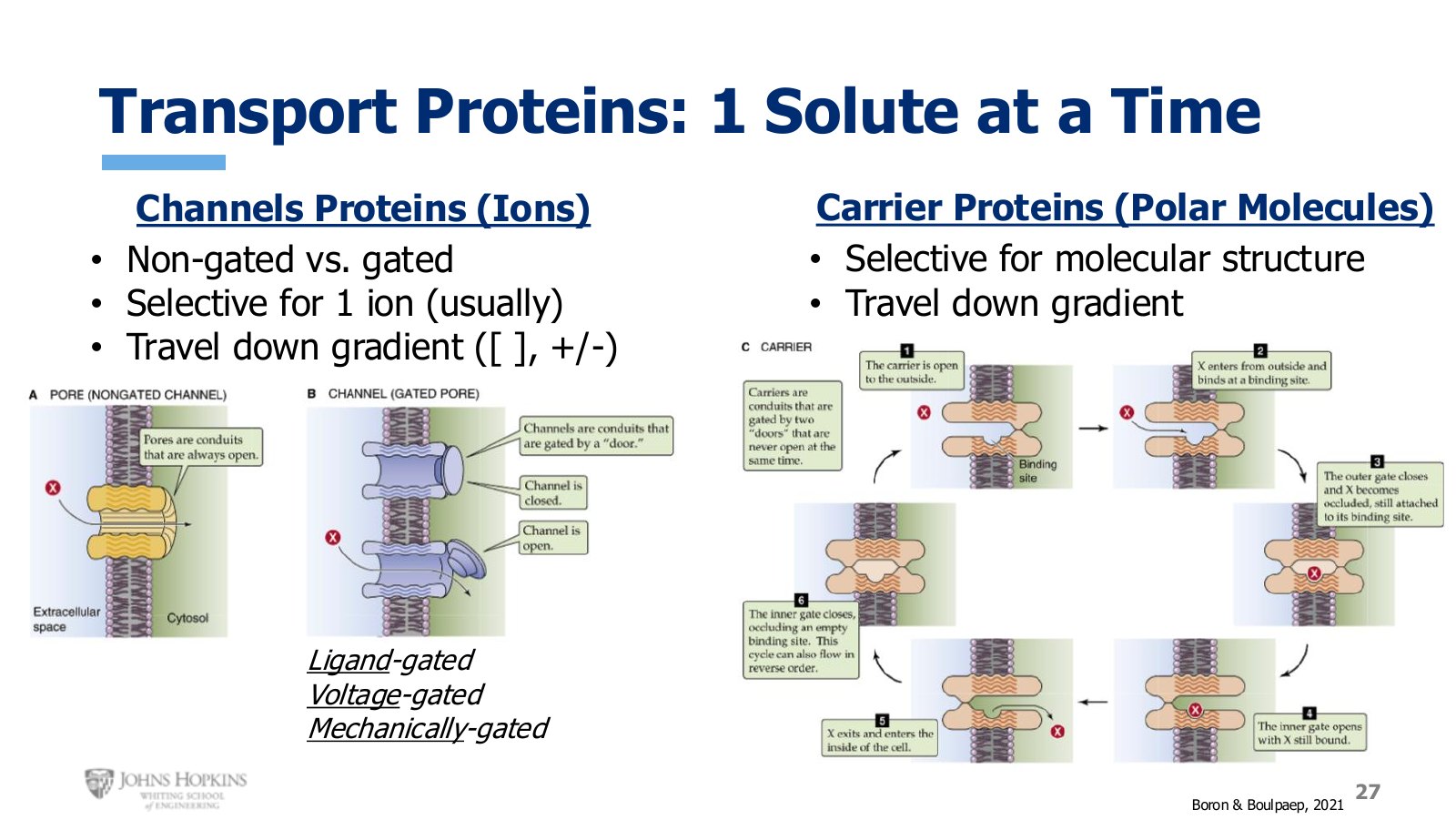
Slide 27. Channels move ions, carriers move polar molecules. Both are selective, both run down the gradient.
Transport proteins for ions are called channels. Transport proteins for polar molecules like glucose and amino acids are called carriers.
Ions use tunnel-like channels to navigate the membrane. Sometimes the channel is exactly that, a tunnel, with the protein forming the wall of an unregulated open pore that allows ions through all the time. These are pores or non-gated channels, the least complex kind, because they never have to coordinate opening and closing.
Far more common are gated channels, closed most of the time and opening only when a specific stimulus is present.
Ligand-gated: opens when a particular ligand binds. Modules 2, 3, and 4.
Voltage-gated: opens in response to a change in electrical potential across the membrane. Modules 2, 4, and 6.
Mechanically gated: opens in response to physical manipulation of the tissue, almost literally pulling the channel open. Implicated in stretch reflexes later in the semester, and in an example later in this module.
Ion channels are selective. This course treats sodium channels, potassium channels, and calcium channels separately, because their highly specific protein structures allow only one type of ion through. Ions passively diffuse down their concentration gradients through their respective channels, based on the strength and direction of that gradient. Because ions are charged, their movement is also influenced by the prevailing electrical gradient, which Module 2 develops.
Carriers are still selective and still move solutes passively down their gradients. The difference is mechanical. Where a channel is a tunnel with or without doors, a carrier works like the automatic double doors at an office building entrance: one set opens and closes behind you before the next set opens.
For glucose entering a cell from the extracellular fluid, it enters through the open outer gate and binds a glucose-specific binding site. The outer gate closes, trapping glucose in the center of the carrier. The inner gate then opens, releasing glucose into the cell. Carriers therefore never form a continuous open pore, so the extracellular and intracellular fluids are never in direct contact.
Two solutes at once
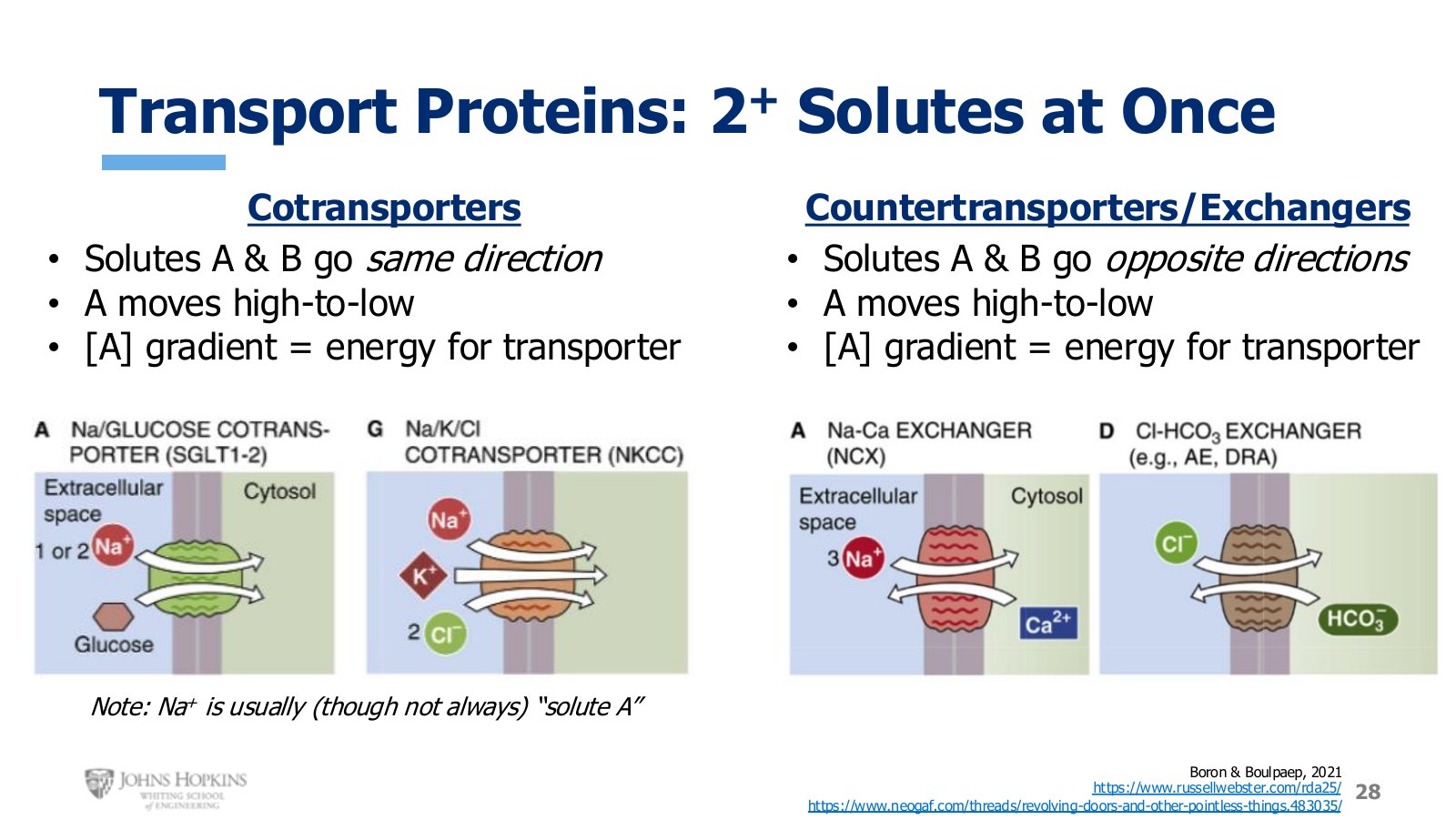
Slide 28. Cotransport and countertransport, both drawn against the revolving-door analogy.
Think of these transporters as revolving doors built for two specific solutes. People can go the same direction through a revolving door, or two people can pass in opposite directions. Either way, one of them has to invest the energy to push the door and get it moving.
Cotransporters move solutes A and B in the same direction. Solute A always moves down its concentration gradient, while B may or may not. The potential energy in A’s gradient is what pushes the door.
The sodium-glucose transporter drives glucose absorption from the intestine into the blood, and reabsorbs glucose from the urine back into the blood. It runs on sodium’s gradient.
The kidney’s NKCC transporter moves one sodium, one potassium, and two chlorides per turn. Sodium’s inward gradient drives it, enabling simultaneous transport of chloride and potassium.
Countertransporters, also called exchangers, move A and B in opposite directions. A still travels down its gradient and holds the energy. B always travels the other way, sometimes up its own gradient, letting A do the heavy work.
The sodium-calcium exchanger helps cardiac muscle cells recover after a contraction.
The chloride-bicarbonate exchanger appears under gas transport in the blood.
Sodium usually serves as solute A in both arrangements. Other solutes are along for the ride.
Active transport: pumps
Sometimes a solute needs to travel up its concentration gradient with no nearby downward gradient to exploit. Moving any solute up its gradient requires energy, like rolling a stone uphill. Without a gradient to borrow from, the transporter needs a dedicated energy source: ATP.
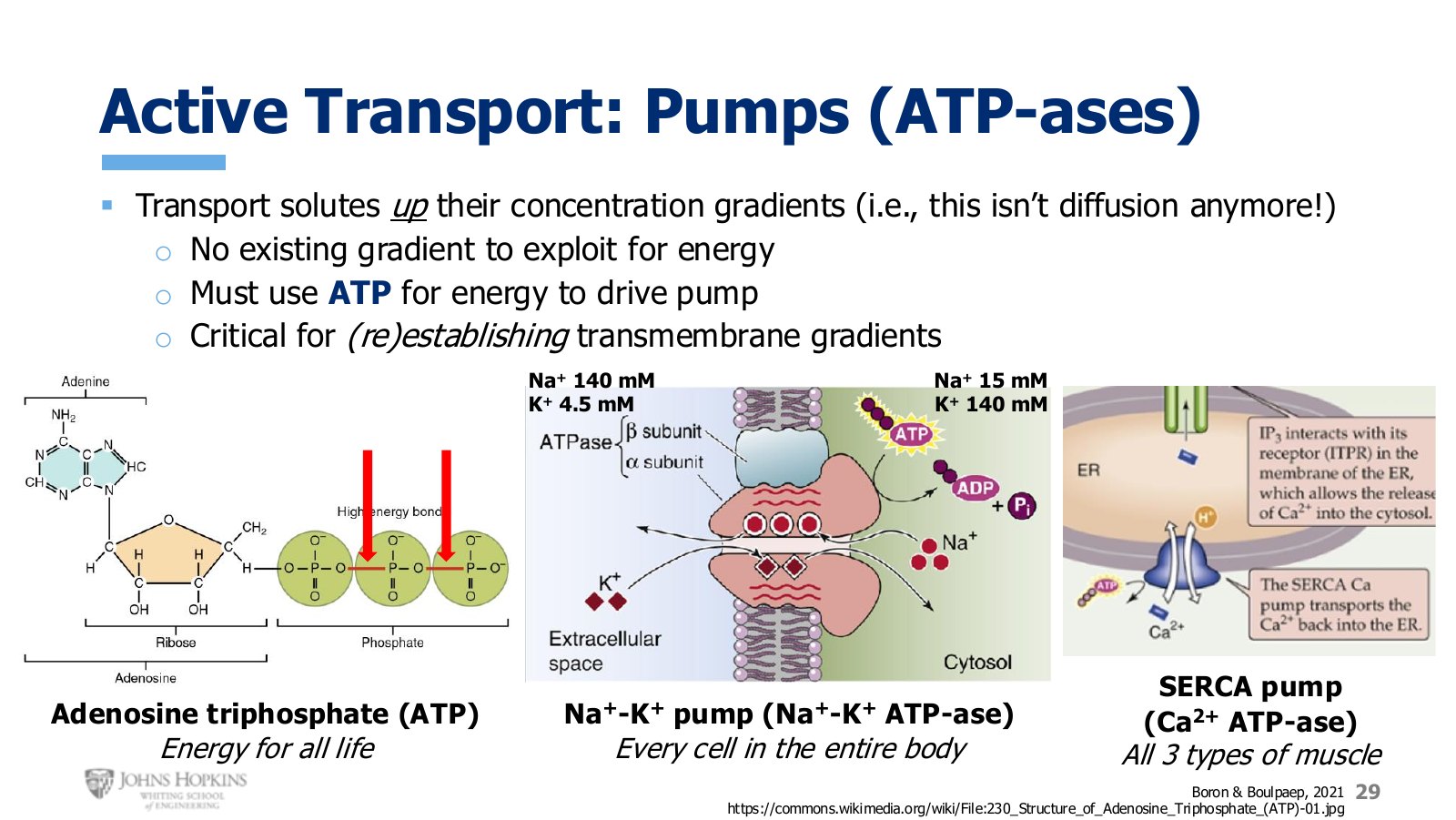
Slide 29. The two pumps this course covers, with the sodium and potassium concentrations they maintain.
ATP is the universal energy molecule in all biological systems, and its chemical potential energy sits in the high-energy bonds between its three phosphates. Any membrane transporter that depends on ATP is a form of active transport, not diffusion. Informally these are pumps. Their official name is ATPases.
Two pumps this semester:
The sodium-potassium pump (Na+-K+ ATPase), found in literally every cell in the body. It holds Na+ at roughly 140 mM outside against 15 mM inside, and K+ at 4.5 mM outside against 140 mM inside.
The SERCA pump (sarcoplasmic/endoplasmic reticulum calcium ATPase), found in all three muscle types.
Both move two solutes in opposite directions, and both move them up their gradients.