2B · Organization of the Nervous System
The nervous system is a communication system. Instantaneous communication that lets the brain and spinal cord monitor and respond to what is going on all over the body.
The brain and spinal cord, being so central to that function, are collectively the central nervous system, or CNS. Nervous tissue outside the brain and spinal cord, the nerves in our eyes and arms and abdomens and legs, is collectively the peripheral nervous system.
The job of the central nervous system is to process incoming sensory information from the far-flung parts of the body and coordinate outgoing motor commands that help the body adjust or respond.
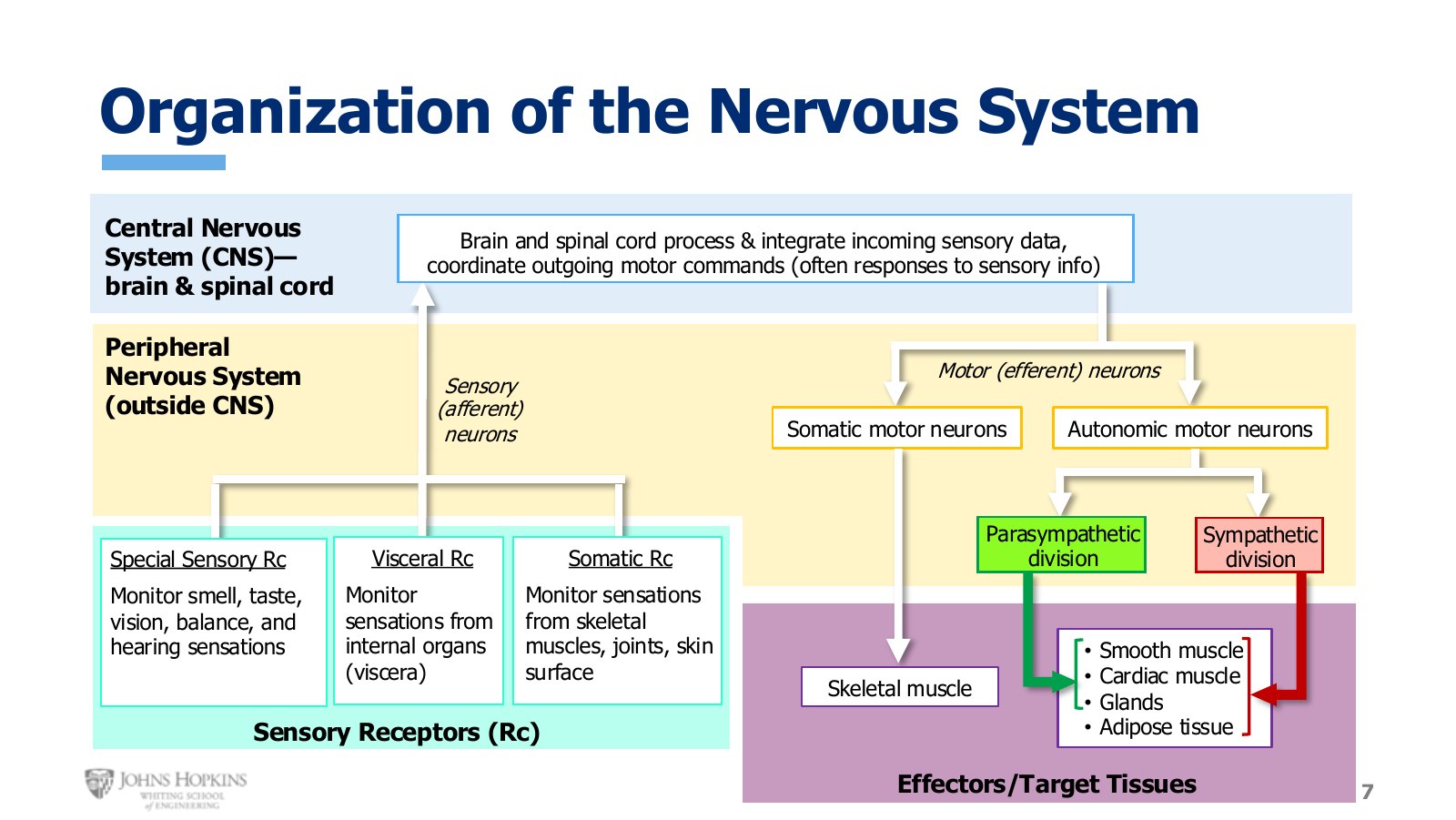
Slide 7. The full map, sensory receptors at the top down to effectors at the bottom. Worth returning to whenever a later module invokes neural control.
Sensory side
Sensory information is first collected in the tissues by specialized cells called receptors.
Visceral receptors monitor what internal organs are experiencing: chemical stimulation of the stomach lining, pH changes in the blood, stretch in the chambers of the heart.
Somatic receptors sit in skin, skeletal muscles, and joints, reporting what we are touching, the position of the body in space, whether joints are moving or stable, whether muscles are stretched or contracting.
Special sensory receptors register the special senses: smell, taste, vision, balance, and hearing.
Once receptors have collected information, it travels to the brain along sensory neural pathways. Sensory neurons are also called afferent neurons, because they send information toward a region of interest, here the brain and spinal cord.
Motor side
Outgoing signals travel along motor or efferent neurons. Efferent means traveling away from a region of interest. The destinations that can address and fix the problem at hand are the effectors, also called target tissues, and which motor pathway a command takes depends on where it needs to arrive.
Somatic motor neurons carry information to skeletal muscle. Pulling your hand off a hot stove.
Autonomic motor neurons carry information to every other effector: cardiac muscle, smooth muscle, glands, and adipose or fat tissue.
The autonomic side splits again. Sympathetic neurons tell effectors to prepare for an imminent stress like exercise, a big exam, or a major presentation. Heart rate and blood pressure go up to deliver more oxygenated blood, the pupils and the airways dilate to help us see and breathe better. Parasympathetic pathways return body systems to quiet resting baseline and focus on functions that would otherwise get in the way during a marathon or a presentation, such as digestion, urine formation, and defecation.
A worked path. Touch a hot stove and pain receptors in the fingertips are stimulated. Sensory neurons carry the hot pain message up to the central nervous system. The central nervous system produces an outgoing response, telling muscles to pull your hand away from the stove.
A word about “receptors”
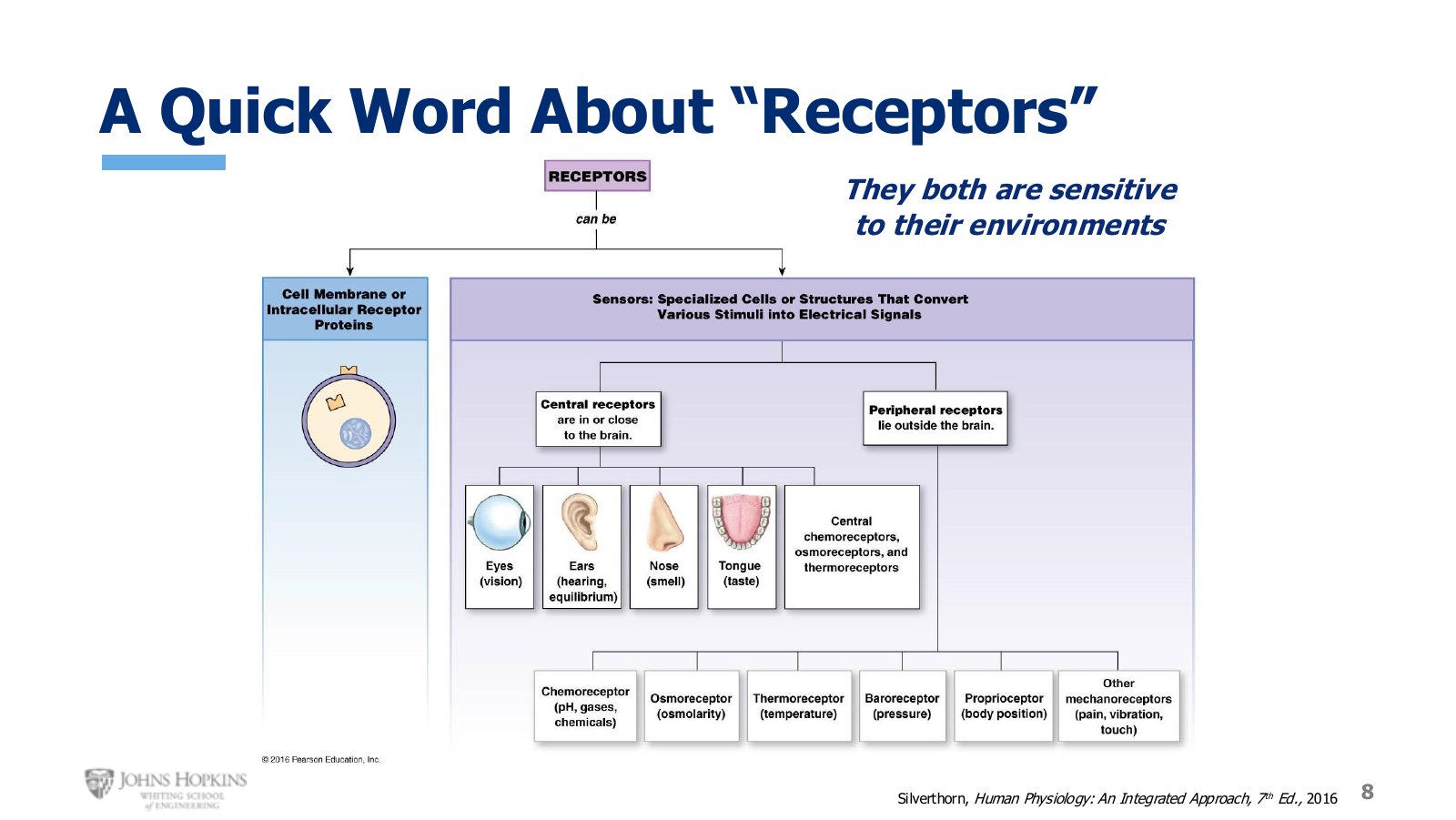
Slide 8. Two structures, one word. Both are sensitive to their environments.
The term receptor has now been used two different ways in two different modules.
In Module 1, a receptor was a cell membrane protein structure that let cells be sensitive to their environments by binding chemicals in the extracellular fluid. Here, a receptor is a specialized cell that takes physical or chemical stimuli, pressure, temperature, stretch, pH, osmolality, gas concentration, light and sound waves, and translates them into electrical signals to pass along to sensory neurons.
Is biology being confusing, using one term for two structures? Yes and no. Yes, because one word with two meanings is ambiguous. But also no, because in both cases the term encompasses the broader meaning of a structure that is sensitive to its environment. Context clues decide which meaning applies, and both kinds appear this semester.