2D · Resting Membrane Potential
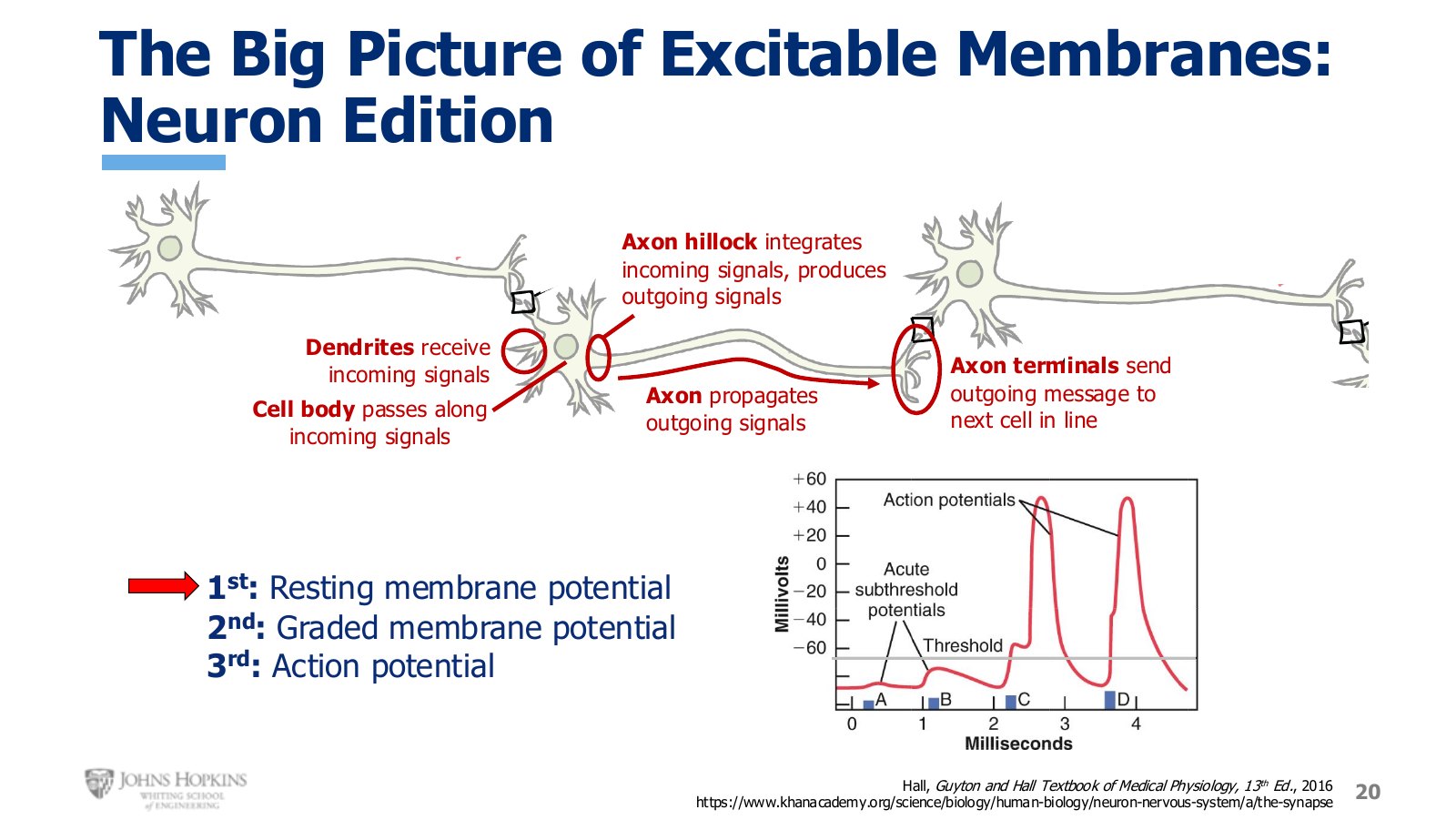
Slide 20. The three electrical states of the neuron, mapped onto the regions that produce them. This figure opens lectures 2D, 2E, and 2F.
The neuron’s regions and their jobs, one more time. Dendrites receive incoming signals from the presynaptic neuron. The cell body passes them to the axon hillock, the edge of the cell body, which integrates incoming signals and stimulates outgoing ones. The axon transmits the outgoing signal to the end of the neuron, and the axon terminals release chemicals to pass the signal on.
Note that the middle neuron has now switched roles. It was the postsynaptic cell receiving a signal from an upstream neuron. It becomes the presynaptic cell sending the signal to a downstream neuron, which becomes the next postsynaptic cell.
Three states run in sequence, and they are the last three lectures of this module.
Resting membrane potential. The neuron is not receiving or processing signals of any kind. The flat portion of the tracing. This lecture.
Graded membrane potential. The neuron is receiving incoming signals and working out what they mean. Lecture 2E.
Action potential. A graded potential met or exceeded threshold, triggering a very big wave of depolarization. The outgoing signal. Lecture 2F.
Which way do the ions want to go?
Take the Nernst figure from lecture 2C, fade out everything that is not sodium or potassium, and move resting potential from −80 mV, an average across several types of excitable membrane, to −70 mV, a better approximation for neurons specifically.
The Nernst potential for sodium is extremely positive relative to resting potential. The Nernst potential for potassium is somewhat negative relative to it. Apply the rules from 2C.
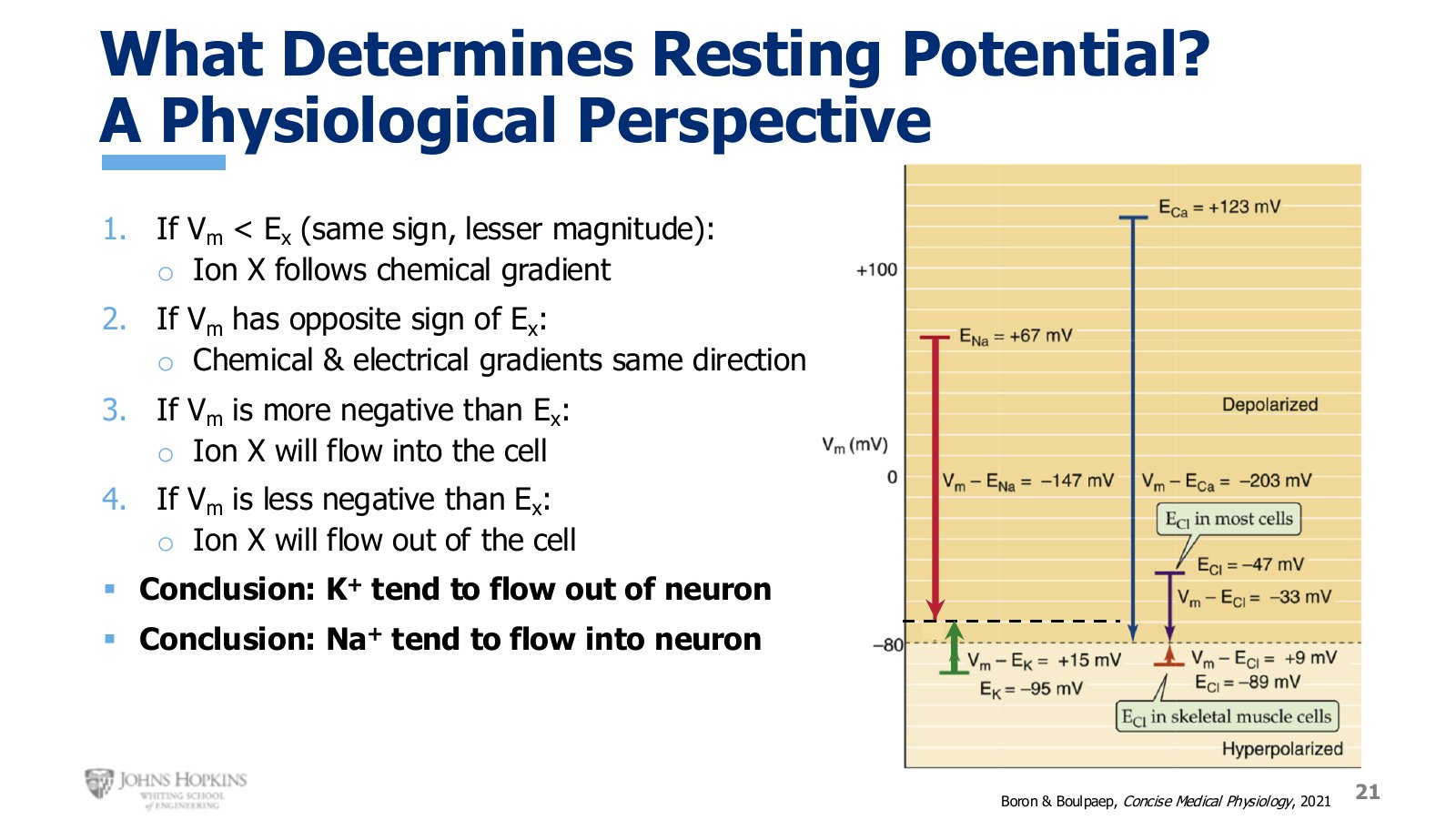
Slide 21. The four applicable rules, and the two conclusions they force.
Resting potential is less than ENa and opposite in sign, so sodium’s concentration and electrical gradients work together in the same direction.
Resting potential is more negative than ENa, so sodium tends to flow into the neuron.
Resting potential is less negative than EK, so potassium tends to flow out of the neuron.
Which channels are actually open?
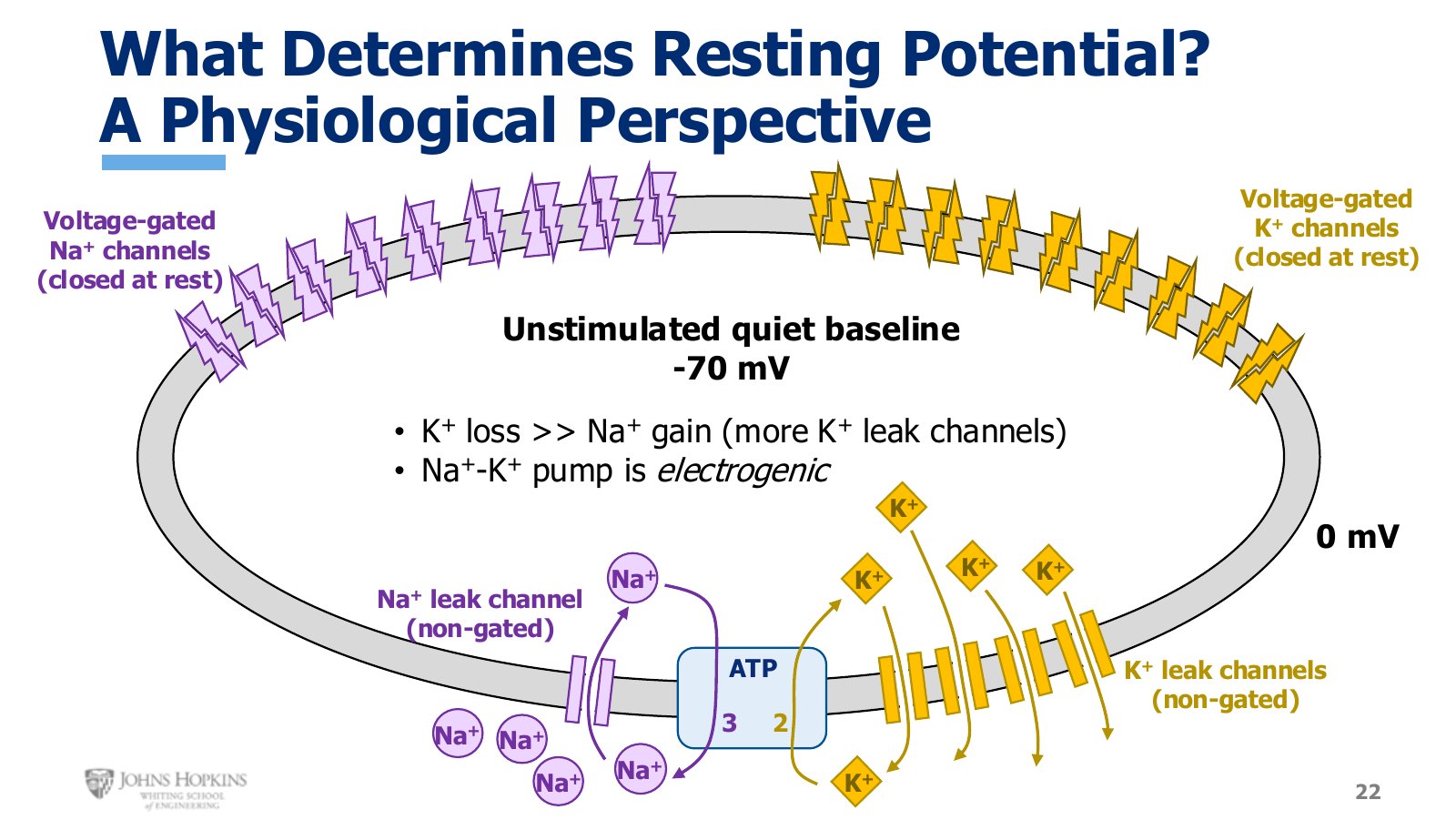
Slide 22. What is running at rest. Voltage-gated channels are present but closed; leak channels and the pump do the work.
The neuron membrane has many voltage-gated sodium and potassium channels, but none of them are open at rest. These channels require a fairly strong depolarizing stimulus to open, so they cannot participate in establishing or maintaining resting potential. They matter later in the module.
Three things are running.
Potassium leak channels, also called ion pores. The most basic type of ion channel, with no way to close or control it, so it is open all the time and allows some degree of outward potassium leakage all the time. At rest, with not much else going on, this small outward leak becomes significant.
Sodium leak channels, present in very small number. So against a steady leakage of potassium out, there is only a very small trickle of sodium in.
The sodium-potassium pump, working all the time. Each turn transports two potassium ions back into the cell as it transports three sodium ions back out, returning them to where they started.
The leak imbalance is what establishes the negative resting potential. With many more potassium leak channels than sodium leak channels, the cell loses positive charges from its interior faster than it gains them, producing a net negative environment inside after a while.
The pump adds to it. Importing two positive charges while exporting three means the pump is very gradually intensifying the negative environment inside. In other words the sodium-potassium pump is electrogenic, not simply maintaining the electrical status quo but actually intensifying an electrical gradient.
Wherever the activity of potassium leak channels, sodium leak channels, and the sodium-potassium pump all come into equilibrium, that is resting potential.
Calculating it
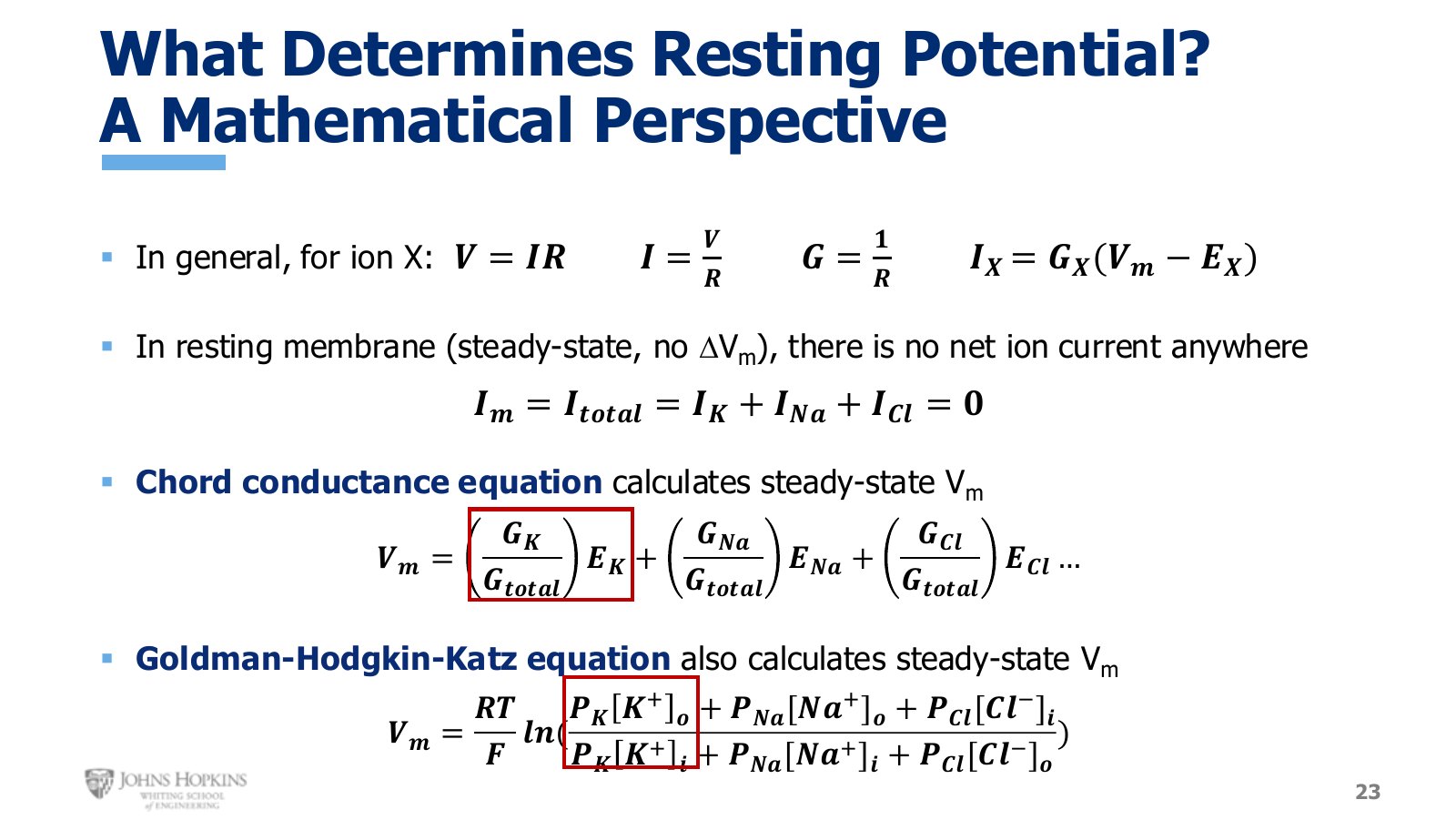
Slide 23. From Ohm’s law to the chord conductance and Goldman-Hodgkin-Katz equations.
Ohm’s law says voltage equals current times resistance. Rearranged, current equals voltage divided by resistance. Conductance is the inverse of resistance. Together they give a physiological version, the current for ion X:
For a resting membrane holding steady at −70 mV, a steady state with no change in membrane potential, the total of all ion currents across the membrane must be zero.
Substitute the first expression into the second, rearrange, and the result is the chord conductance equation.
This considers each ion separately, then adds their influences. For potassium: conductance for potassium, essentially how many potassium channels are open, divided by total conductance for all ions, essentially how many channels total are open at the moment, times the Nernst potential for potassium, which is where membrane potential would sit if only potassium channels were open. Then repeat for sodium, and for as many ions as are crossing the membrane at rest.
The key is that the ion with the most open channels is the most heavily weighted. In the resting neuron, potassium conductance is a very high percentage of total conductance, with just a little sodium conductance added into the mix.
The Goldman-Hodgkin-Katz equation calculates steady-state membrane potential too, and is overtly based on the Nernst equation from lecture 2C. Instead of one ion’s concentrations, it takes as many ions as needed and weights each by its relative permeability at rest.
Permeability and conductance are technically two separate things, but they are functionally so similar that permeability in the Goldman equation plays the same role conductance did in the chord conductance equation.