2E · Graded Potentials
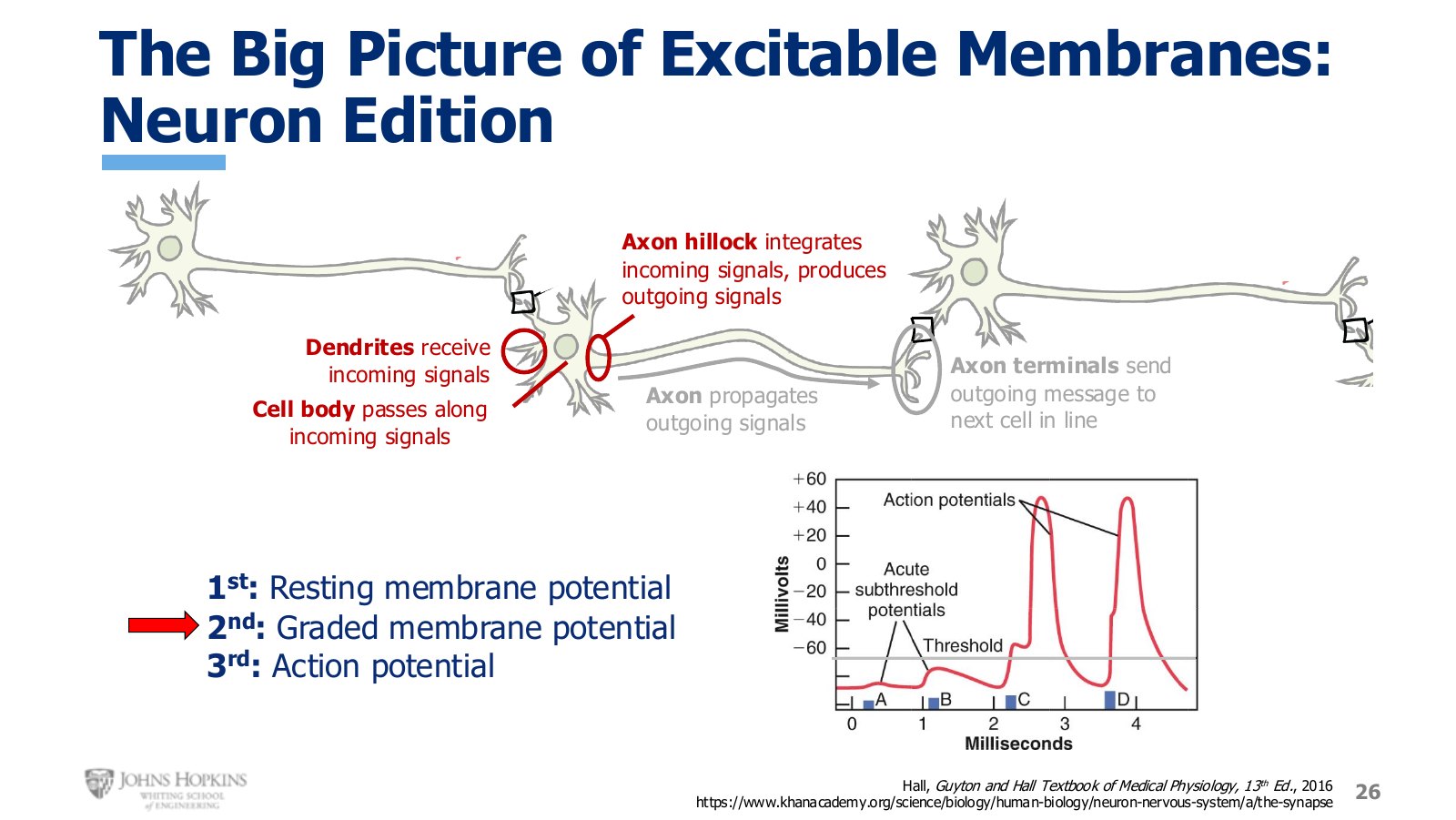
Slide 26. The three neuron states again. This lecture is the second: graded potentials in the dendrites and cell body.
This lecture covers how dendrites receive incoming signals, how the cell body handles them, and how the axon hillock interprets them. Axon propagation and events at the axon terminals wait for 2F.
Keep threshold in mind throughout. Graded potentials, the small bumps on the waveform, will not stimulate the cell to produce an outgoing signal unless they meet threshold.
The binary problem
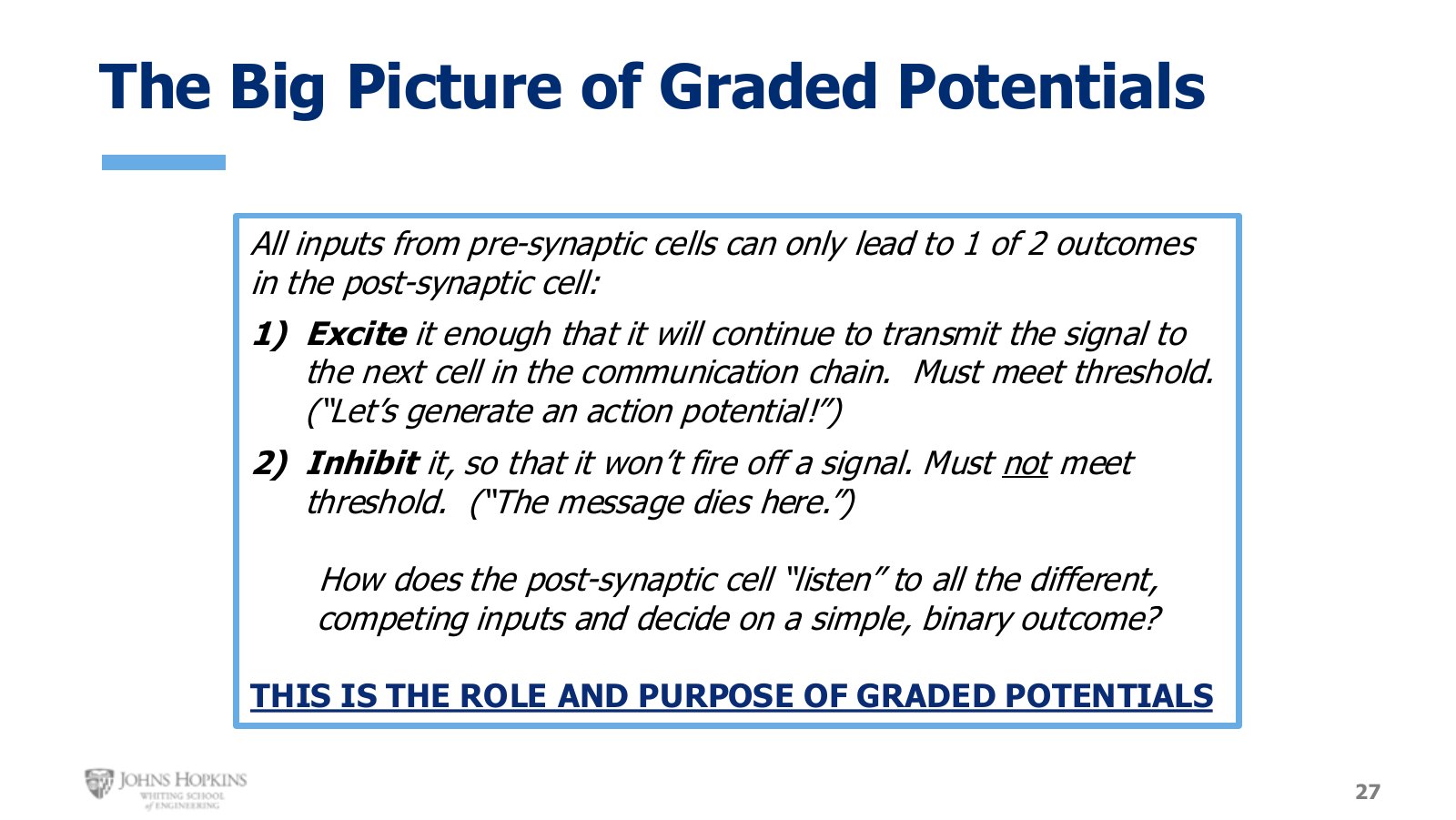
Slide 27. Every input leads to one of two outcomes. Graded potentials are how the cell decides which.
All incoming signals from presynaptic cells can only lead to one of two outcomes for the postsynaptic cell. Either they excite the cell enough that it meets threshold and continues transmitting the signal down the line, or they inhibit it, preventing membrane potential from meeting threshold and killing the transmission. Both excitatory and inhibitory influences are vital to the functioning of the nervous system.
So how does a postsynaptic cell listen to all the different and potentially competing presynaptic inputs and decide on a simple send-or-kill outcome? That is the role and purpose of graded potentials.
Chemical signal into electrical signal
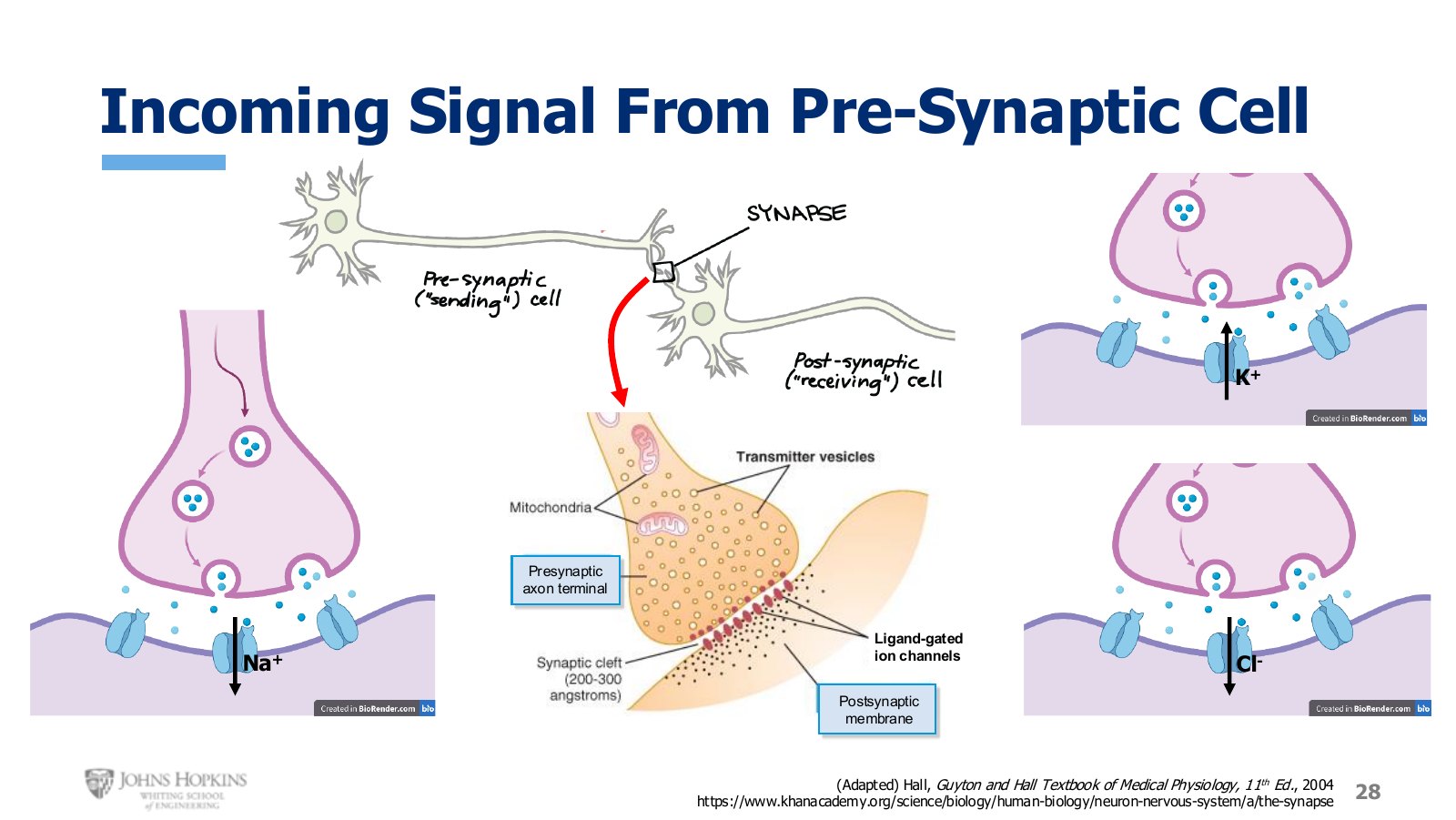
Slide 28. The incoming signal arrives as neurotransmitter and lands on ligand-gated ion channels.
When the axon terminal on the presynaptic cell is ready to send its message, it releases molecules called neurotransmitters. These bind to and open certain ligand-gated ion channels on the postsynaptic membrane. Opening channels lets ions flow, which starts to change membrane potential in the postsynaptic cell. The ligand-gated channel is what converts a chemical signal into an electrical one.
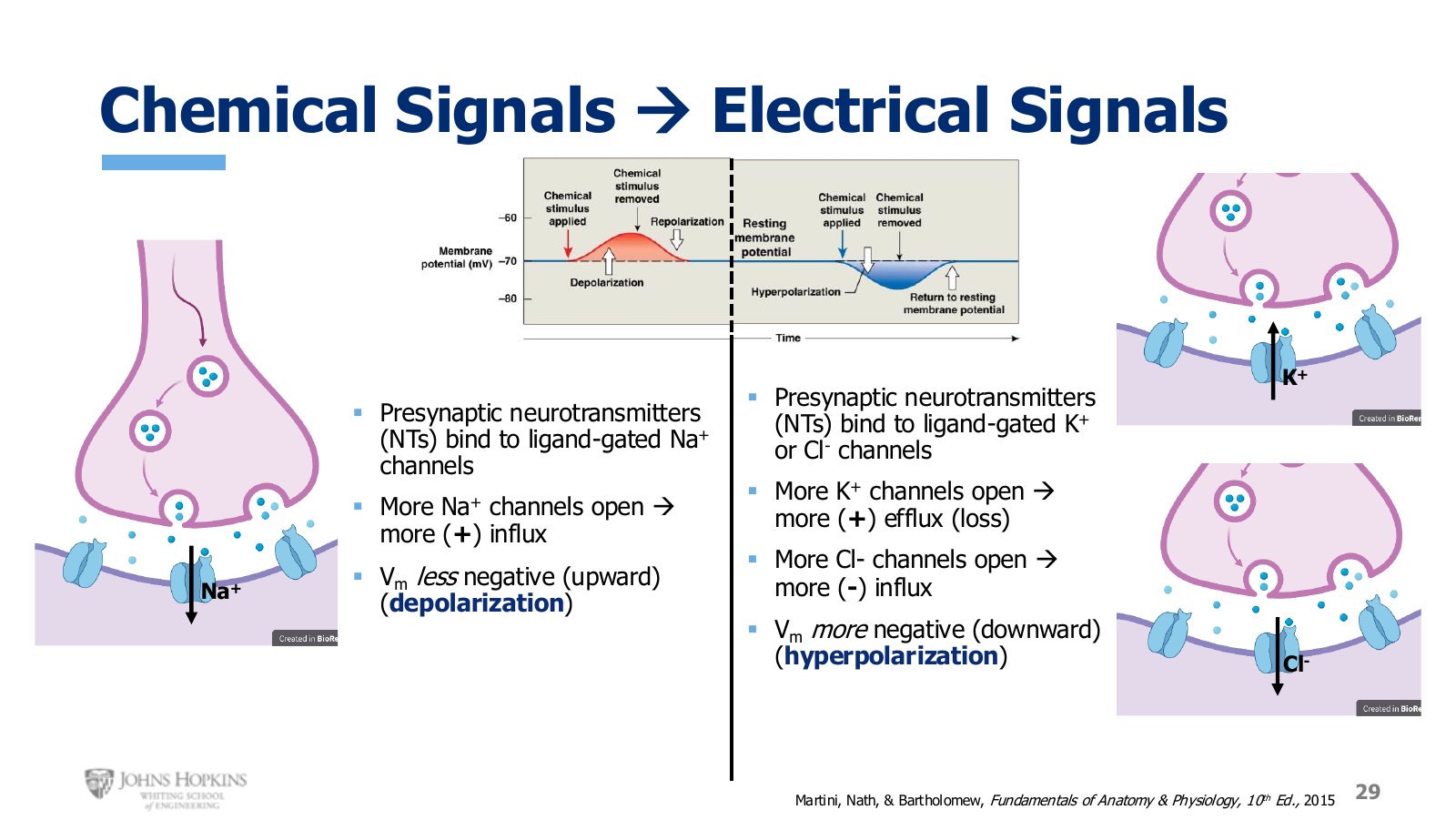
Slide 29. Sodium influx drives the trace up. Potassium efflux or chloride influx drives it down.
Some neurotransmitters open ligand-gated sodium channels, letting sodium flow into the cell. Others open ligand-gated potassium channels, letting potassium out, or ligand-gated chloride channels, letting chloride in. The influx of positive ions has a different effect on membrane potential than the efflux of positive ions or the influx of negative ions.
Sodium in. Positive charges arrive, the inside becomes less negative, and membrane potential deflects upward from −70 toward −60. Depolarization.
Potassium out or chloride in. Potassium takes its positive charges with it; chloride brings negative charges in. Either way the inside becomes more negative and membrane potential deflects downward from −70 toward −80. Hyperpolarization.
EPSPs and IPSPs
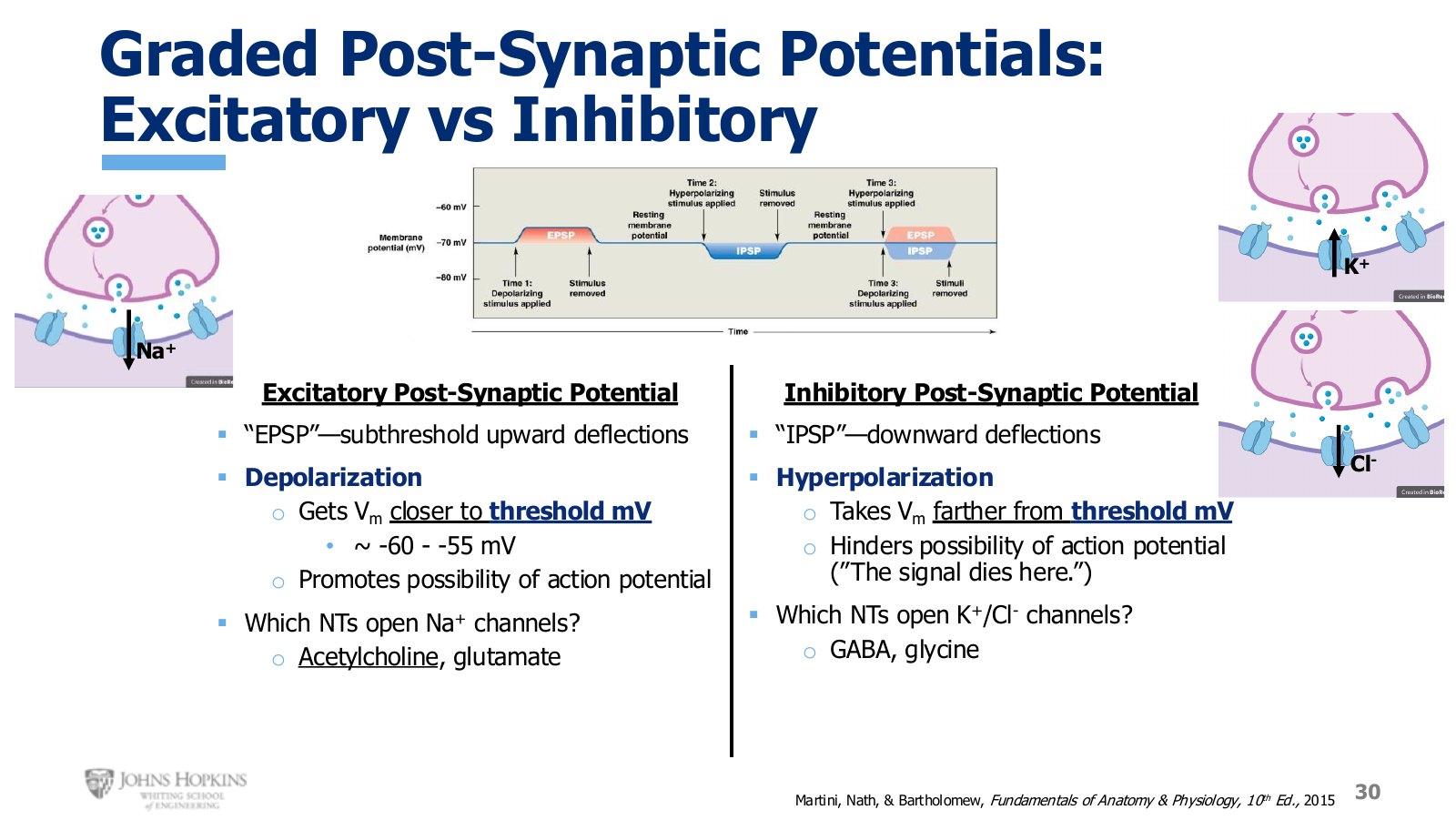
Slide 30. The two named graded potentials, with the neurotransmitters that produce each.
The subthreshold upward deflection is an excitatory postsynaptic potential, or EPSP. It counts as excitatory because depolarization gets membrane potential closer to threshold, which for neurons usually sits between −60 and −55 mV, promoting the possibility of hitting threshold and triggering an outgoing action potential. This is the literal definition of exciting an excitable membrane.
The neurotransmitters that usually trigger EPSPs are acetylcholine and glutamate. Glutamate is a very common excitatory neurotransmitter in the brain. Acetylcholine is very common in the peripheral nervous system, especially on the motor side, and appears this semester in somatic motor control of skeletal muscle and autonomic motor control of cardiovascular function.
The downward deflection is an inhibitory postsynaptic potential, or IPSP. It counts as inhibitory because hyperpolarization takes membrane potential deeper into negative territory, further from threshold, making it even less likely threshold is reached. If threshold is not reached, the signal stops traveling down the chain.
Common inhibitory neurotransmitters, which open potassium or chloride channels, are GABA and glycine, both very common in the central nervous system. This course does not study many IPSP examples explicitly, but they are critical elements in most neurological reflexes in the body.
If excitatory and inhibitory neurons fire on a postsynaptic cell at the same time, their signals can cancel each other out, leading to no change in postsynaptic membrane potential.
The decay problem
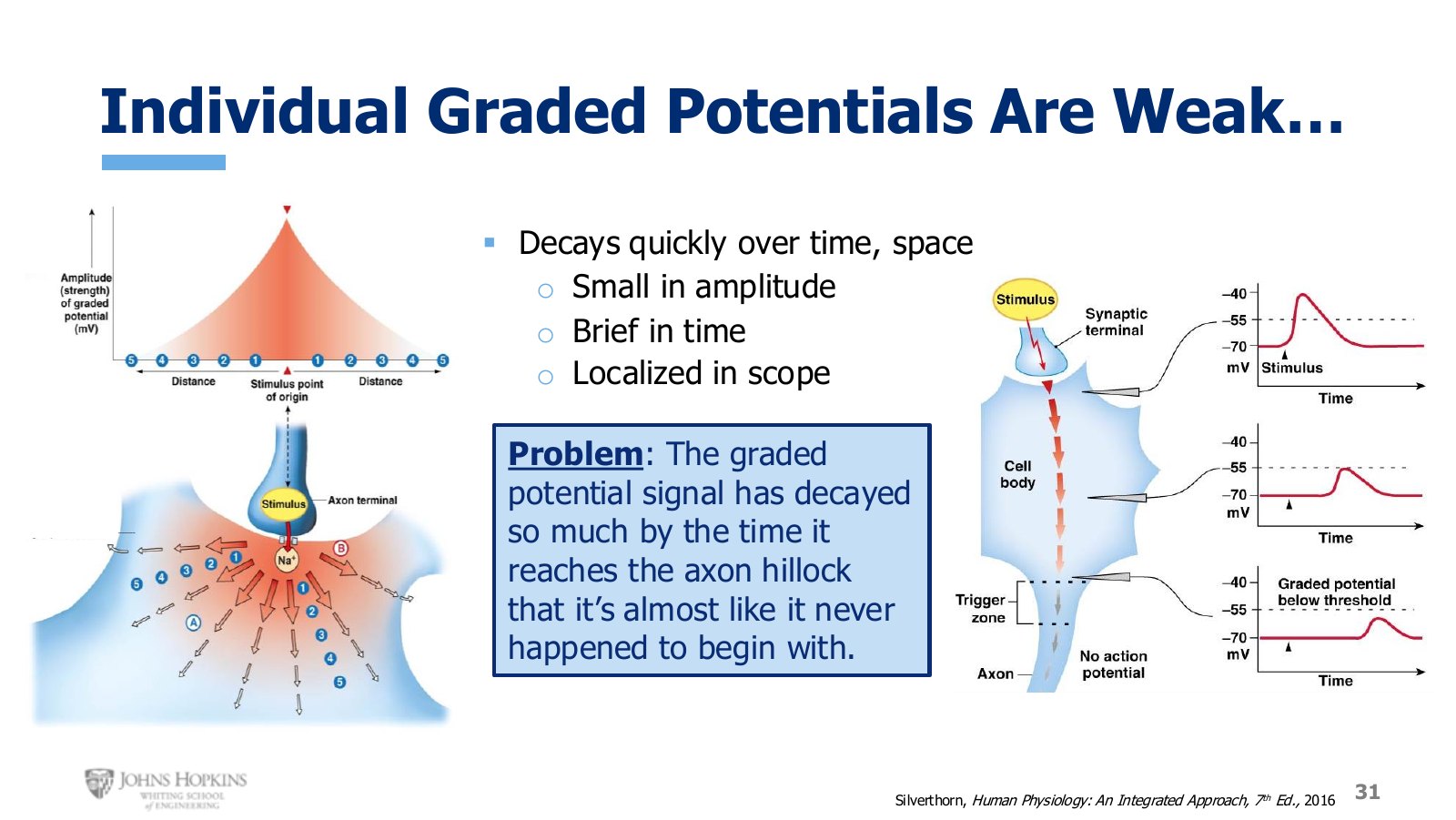
Slide 31. A graded potential is strongest at the synapse and weakens dramatically as it spreads across the cell body.
Individual EPSPs and IPSPs are weak electrical signals. They decay quickly over both time and space. They have relatively small amplitudes to begin with, they do not last very long, and they cannot spread far before disappearing.
Here is the critical part. Even though the synapse may sit out on a dendrite, or where the dendrite meets the cell body, the graded potential has to travel all the way to the axon hillock at the opposite end of the cell body. The axon hillock is where all graded potentials are summed and integrated, and where the neuron decides whether to produce an action potential.
If the graded potential meets or exceeds threshold at the axon hillock, the neuron produces an action potential. If it is below threshold when it arrives, there is no action potential. Most of the time graded potentials are too weak by the time they arrive. They may start out fairly strong, but they lose amplitude in transit, and by arrival they no longer have sufficient strength to excite the neuron.
Summation
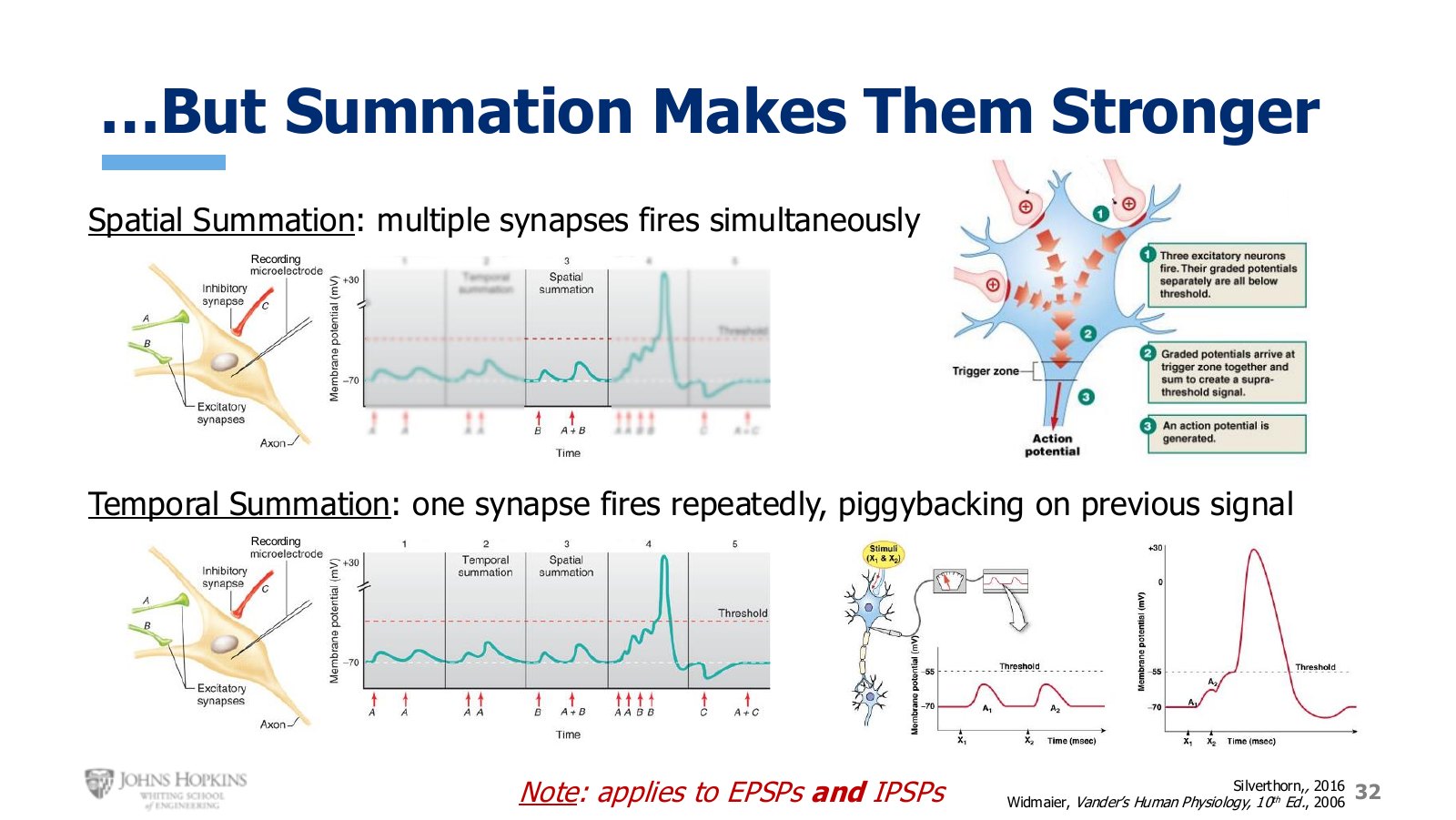
Slide 32. Temporal summation stacks signals in time from one synapse. Spatial summation stacks them across synapses.
If one graded potential cannot make the trip without degrading below threshold, add several together. Two types of summation do this, and both work on EPSPs and IPSPs alike.
Spatial summation occurs when multiple synapses transmitting the same graded potential fire at the same time. It spatially expands the surface area of postsynaptic membrane experiencing the graded potential, vastly increasing the number of ion channels that open and therefore the number of ions crossing the membrane. Fire one excitatory terminal and you get a fairly small EPSP. Fire two at once and the depolarization is more pronounced. On the course figure you would need another five or ten excitatory neurons at the party to actually reach threshold, but the principle holds: several neurons firing at once produce a much greater deflection than one.
Temporal summation, or summation over time, occurs when one synapse fires repeatedly and frequently enough that the newest graded potential can piggyback on previous signals before they decay. One presynaptic neuron firing twice with a delay between means the first EPSP has fully degraded by the time the second arrives. No summation, no threshold. Fire twice in rapid succession and the second EPSP builds on the amplitude of the first, which has not fully degraded. That boosts signal strength and threshold is reached.
The outcome is binary. Below threshold at the axon hillock, the neuron is inhibited and no action potential is produced. That is the end of the story. At or above threshold, an action potential is triggered.