2C · Neuron Structure, Gradients, and Nernst Potentials
Structure dictates function, so start with the anatomy. Neurons come in many shapes and sizes. The one used here is a motor neuron, the typical introductory neuron shape students learn first.
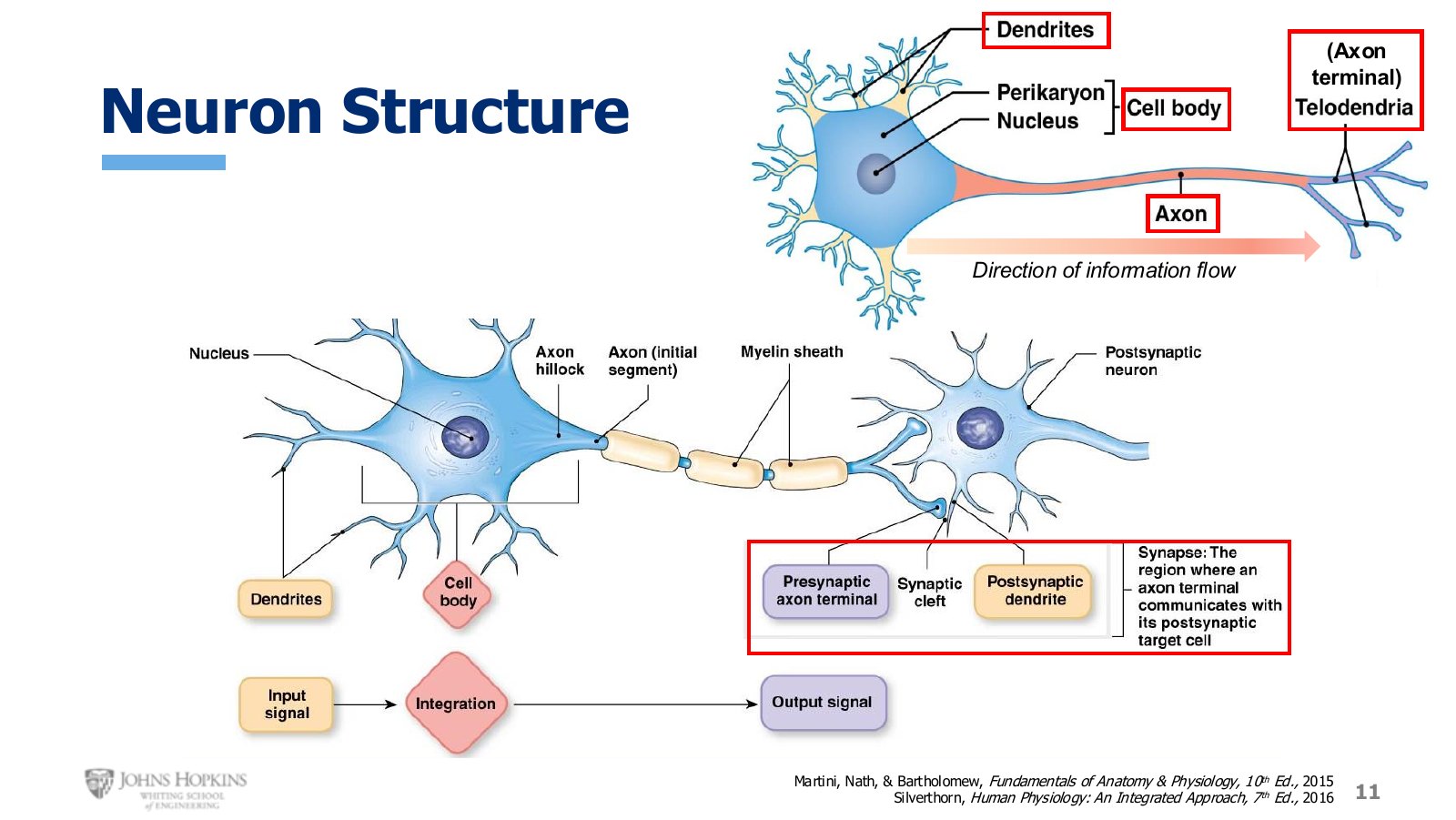
Slide 11. Neuron anatomy, color-coded by region, with the direction of information flow marked. Signals travel one way only.
Information travels in one direction: dendrites, cell body, axon, then the telodendria, also called axon terminals.
Dendrites receive incoming information, the input signal.
Cell body passes the signal along and helps integrate incoming signals.
Axon hillock, where the cell body meets the axon. Important later in this module.
Axon carries the output signal down its length.
Axon terminals release chemicals that pass the signal to the next cell in line.
Myelin sheaths are an optional accessory wrapping around axons that some neurons have. More on this in lecture 2F.
Wherever a neuron meets the next cell in line, whether another neuron or a target tissue cell, that junction is a synapse. The cell bringing information to the synapse is the presynaptic cell. The cell receiving it is the postsynaptic cell. The microscopic space between them is the synaptic cleft.
Electrochemical gradients
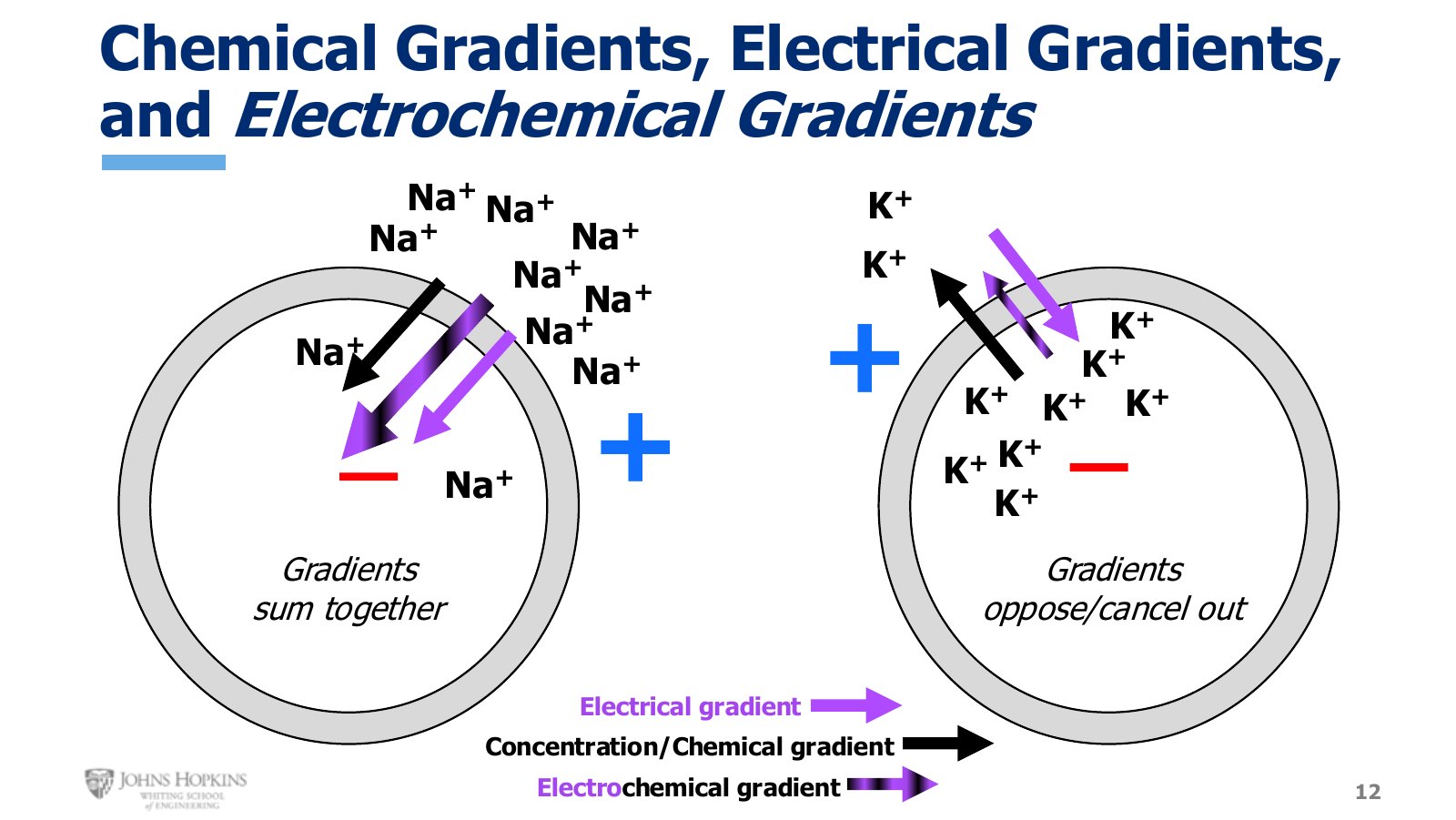
Slide 12. Chemical and electrical gradients for sodium and potassium. For sodium they sum; for potassium they oppose.
Module 1 covered concentration gradients. Lecture 2A introduced electrical gradients. Now consider them together.
Sodium. More sodium sits outside the cell than inside, so the chemical gradient is directed inward, drawing sodium in. Sodium also carries a positive charge, and like charges repel while opposite charges attract, so sodium is also drawn toward the relatively negative interior. Its electrical gradient is inward too. The combined influence is the electrochemical gradient, and here the two gradients sum, giving a very powerful inward pull. If sodium channels happen to be open, sodium movement into the cell is fast and furious.
Potassium. Potassium is more concentrated inside, so its chemical gradient points outward. But potassium is also positive, so it is attracted to the negative interior, and its electrical gradient points inward. The two work in opposite directions. Like any vector summation, equal and opposite forces cancel and nothing moves. In excitable cells, potassium’s electrical gradient is a bit weaker than its concentration gradient, so potassium does leave the cell, though with less gusto than sodium entered.
Electrochemical equilibrium
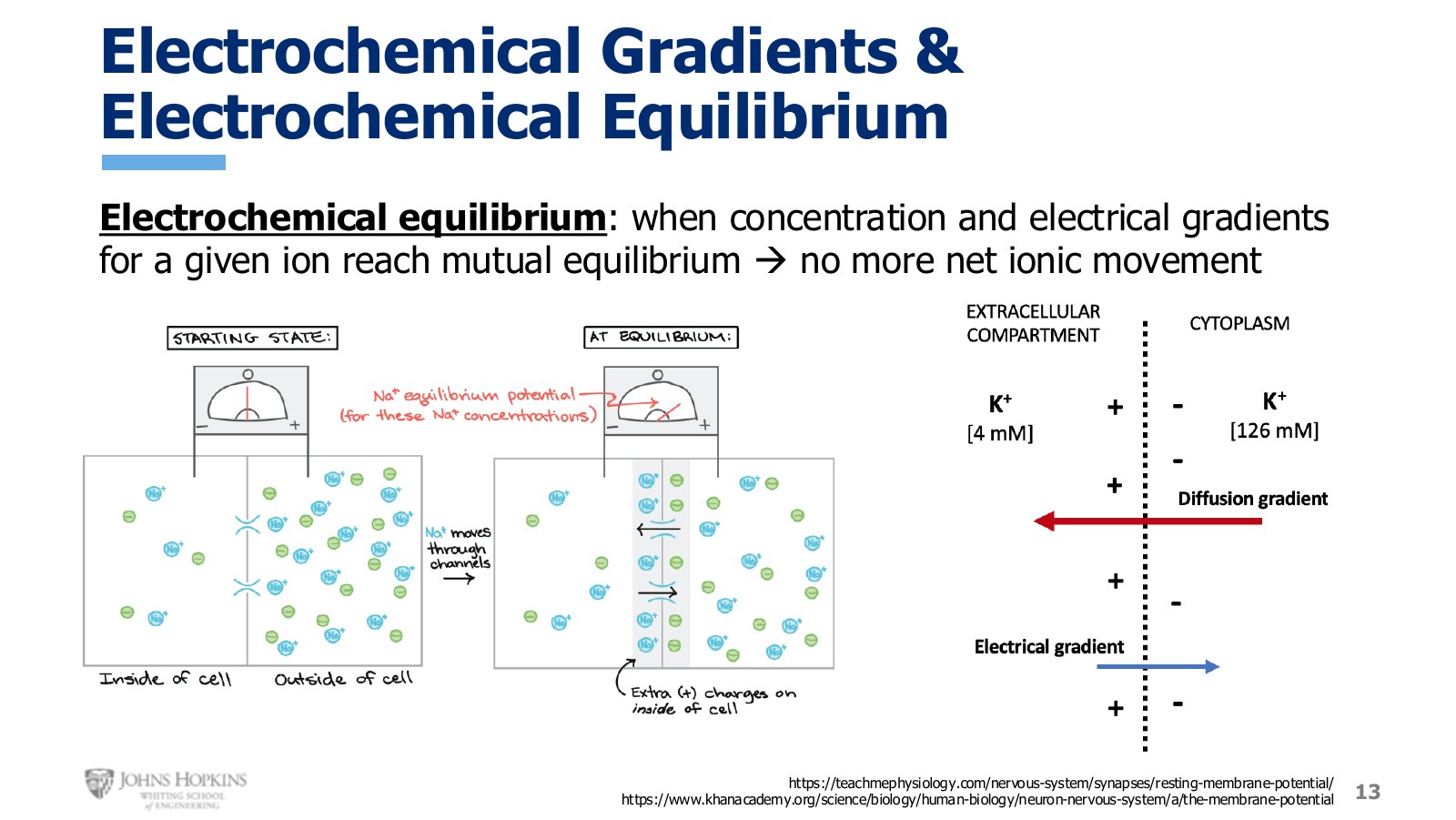
Slide 13. Electrochemical equilibrium. Neither gradient is zero; they simply hold each other in check.
Electrochemical equilibrium occurs when the chemical and electrical gradients for a given ion reach mutual equilibrium, with no more net movement of the ion.
Sodium. Start midway through sodium influx, which has already brought transmembrane voltage from −70 mV up to 0 mV. That is technically electrical equilibrium, no charge difference between compartments, but there is still far more sodium outside, so nowhere near concentration equilibrium. Sodium keeps entering, following its concentration gradient, making the inside more and more positive. At some strongly positive voltage, the inward concentration gradient is opposed by a now outward electrical gradient, because positive charge inside repels the influx of more positive charge. Neither a complete concentration equilibrium nor a neutral electrical equilibrium, but two equally powerful gradients in opposite directions holding each other in check.
Potassium. The starting scenario differs. At −70 mV there is a very strong outward concentration gradient, which would make the inside even more negative, and a moderate inward electrical gradient, because potassium’s positive charge is attracted to the negative interior. As more potassium leaves, the inside grows more negative, which strengthens the electrical gradient pulling potassium back in. Somewhere in fairly negative territory, the two opposing gradients are equally strong and hold each other in check.
The Nernst equation
For each ion, the precise transmembrane millivoltage at which electrochemical equilibrium occurs can be calculated. That value is the Nernst equilibrium potential, presumably because Dr. Nernst was the one who figured out how to calculate it. For ion X it is abbreviated EX.
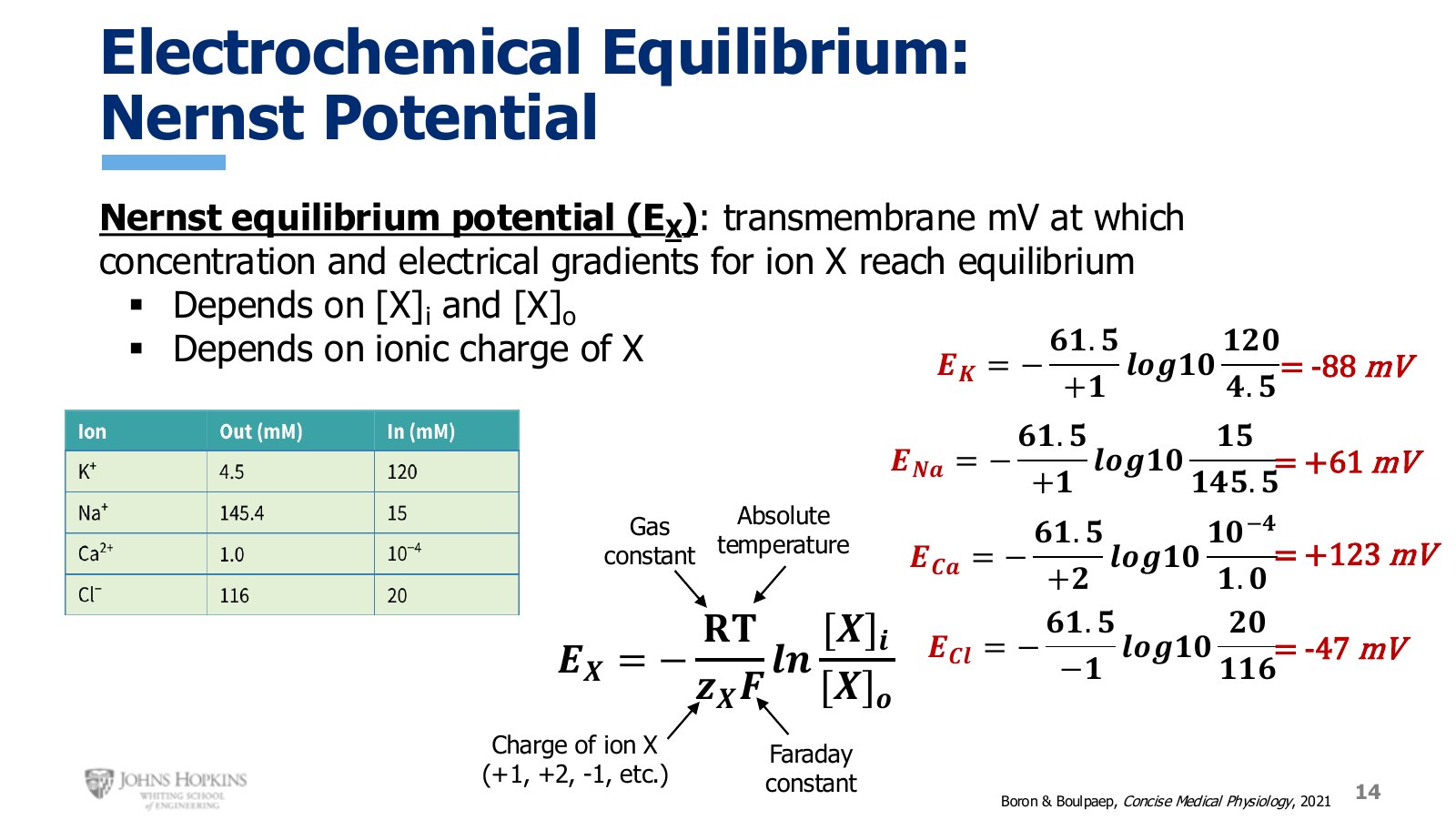
Slide 14. The Nernst equation with each term labeled, and four ions worked through.
It is the negative value of the gas constant times absolute temperature, 310 K for the human body, divided by the charge of ion X times the Faraday constant. Multiply that by the natural log of the concentration of ion X inside the cell divided by its concentration outside.
Everything besides charge and the two concentrations is a constant. Run the math on the constants first and convert from natural log to log base 10, and you get the version most often cited in textbooks.
Nernst potentials from the course chart
Ion | Charge | Inside | Outside | EX |
|---|---|---|---|---|
Potassium | +1 | 120 | 4.5 | −88 mV |
Sodium | +1 | 15 | 145.5 | +61 mV |
Calcium | +2 | 10−4 | 1.0 | +123 mV |
Chloride | −1 | 20 | 116 | −47 mV |
What Nernst potentials tell us
Slide 15. The Nernst equation assumes one permeant ion. Real cells have several, so Nernst potentials reveal tendencies rather than real voltages.
The Nernst equation applies only to a cell freely permeable to one ion at a time, while most normal living cells have limited permeability to several ions at once. So Nernst potentials do not apply directly to real life situations. They do two useful things anyway: they reveal how ions want to behave, and the equations in lecture 2D that calculate real resting voltage rely on them.
Given a membrane potential, Vm, and the Nernst potential for an ion, its behavior is predictable.
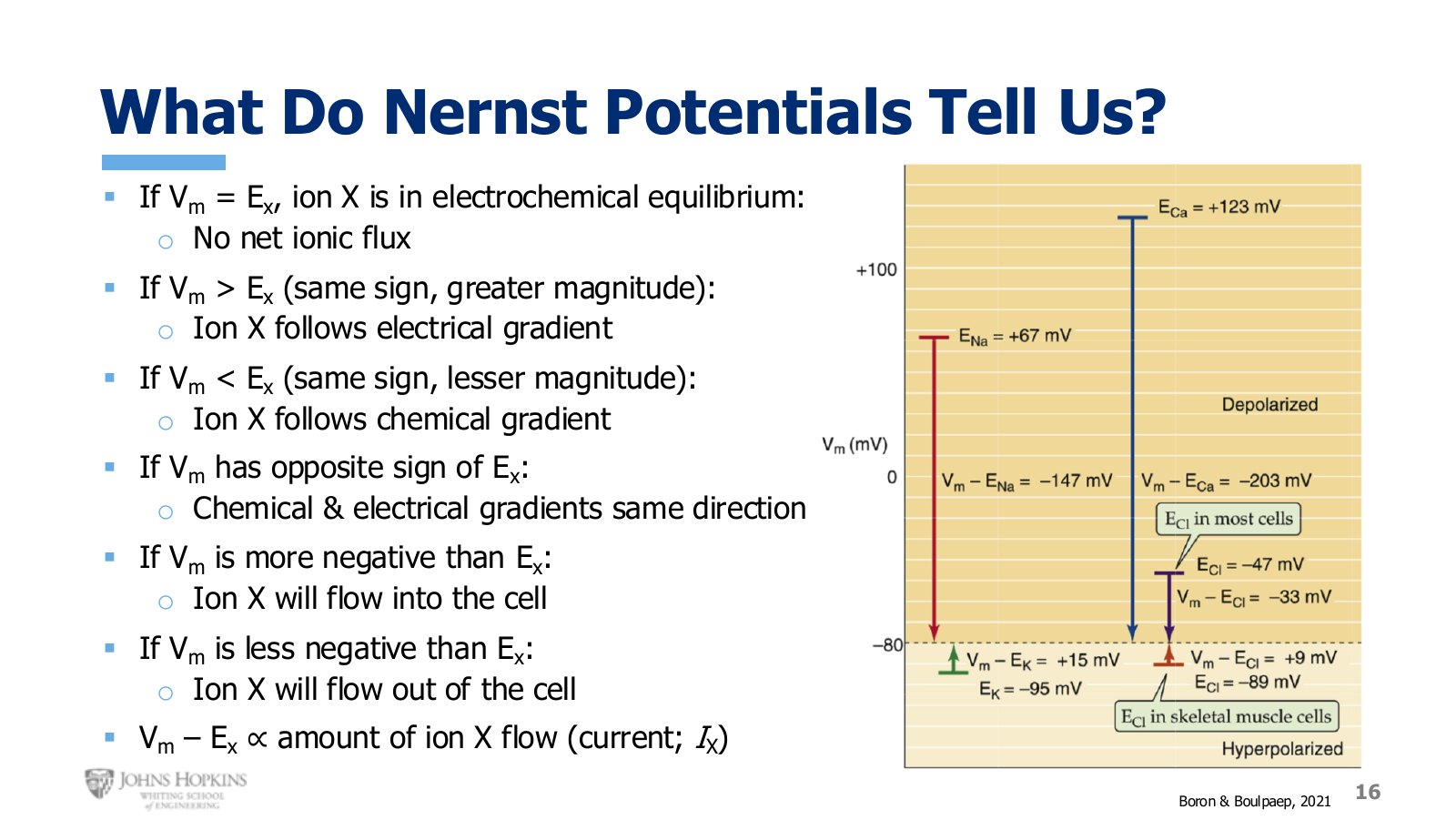
Slide 16. The rules for reading an ion’s behavior from Vm against EX, beside the Boron & Boulpaep figure they come from.
Reading an ion’s behavior from Vm against EX
Condition | What ion X does |
|---|---|
Vm = EX | In electrochemical equilibrium. No net ionic flux. |
Vm > EX (same sign, greater magnitude) | Follows its electrical gradient. |
Vm < EX (same sign, lesser magnitude) | Follows its chemical gradient. |
Vm opposite in sign to EX | Chemical and electrical gradients point the same direction and sum. |
Vm more negative than EX | Flows into the cell. |
Vm less negative than EX | Flows out of the cell. |
And the difference Vm − EX is proportional to the amount of ion flow across the membrane, the current for that ion.
The membrane as a circuit
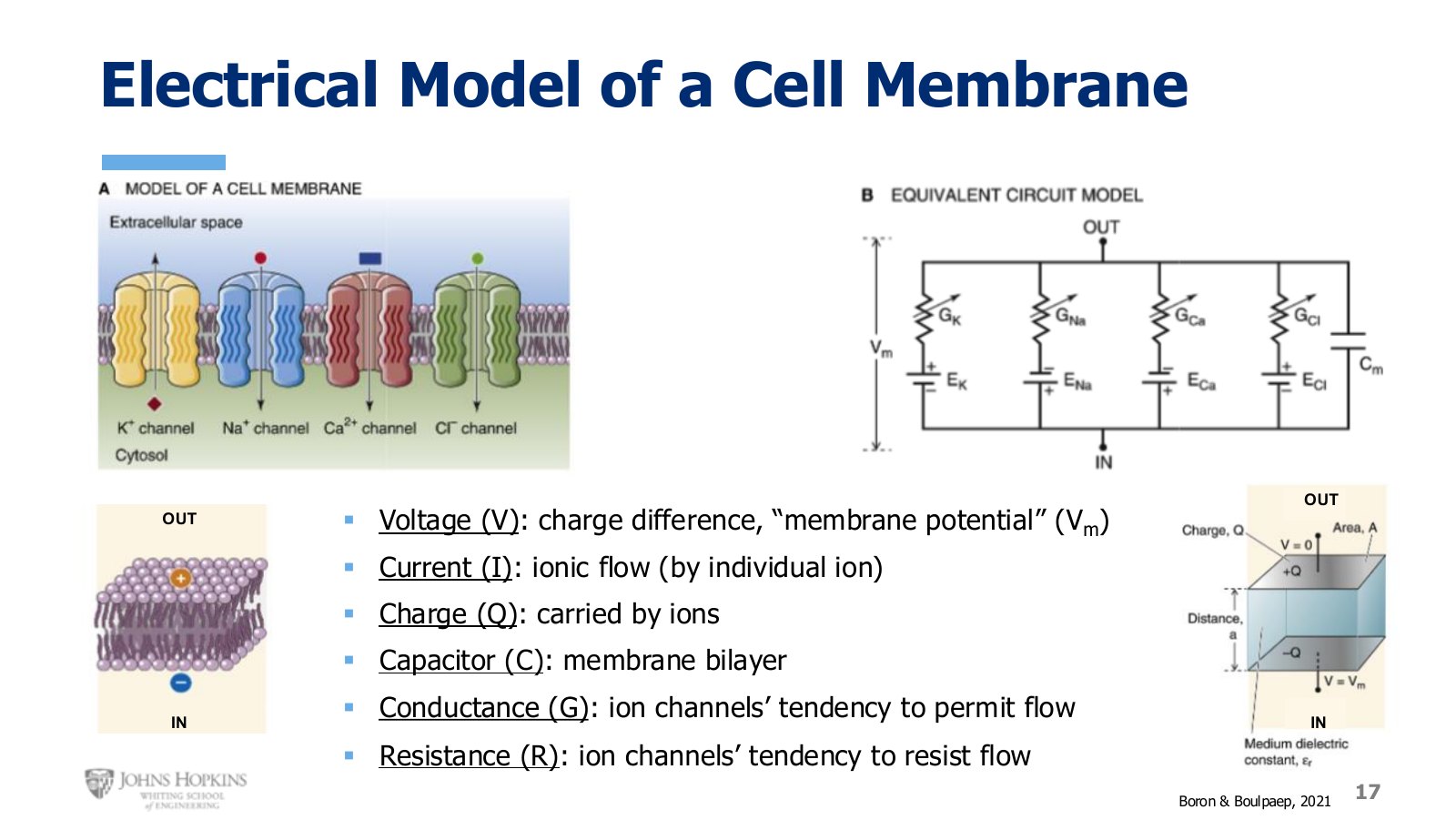
Slide 17. The electrical model. Each circuit element maps onto a physical part of the membrane.
Excitable membrane function is quite analogous to inorganic electrical circuits.
- Voltage (V)
- The charge difference between the two sides of the membrane, abbreviated Vm and called the membrane potential.
- Current (I)
- The flow of an individual ion species across the membrane. Sodium currents are discussed separately from potassium or calcium currents.
- Charge (Q)
- Carried by the ions, positive or negative.
- Capacitor (C)
- The membrane itself. As a hydrophobic lipid bilayer it stops the flow of hydrophilic ions.
- Conductance (G)
- The ion channels’ tendency to permit flow. Related to the number of open channels.
- Resistance (R)
- The ion channels’ tendency to resist flow. Related to the number of closed channels. Conductance and resistance are reciprocal.