3E · Modulation of Force Production
Two facts sit in tension. Skeletal muscle cells are remarkably consistent in the twitch contractions they produce, with great repeatability time after time. But we rarely need the same force twice. Holding a moving box full of books is very different from holding a newborn baby. The grip strength for opening a new pickle jar is very different from the grip strength for carrying and cracking eggs.
Slide 34. The problem and the three solutions: length-tension, frequency of stimulation, motor unit recruitment.
If the cells reliably produce the same force under a given set of conditions, then the way to vary force is to change the conditions. There are three ways.
1. The length-tension relationship
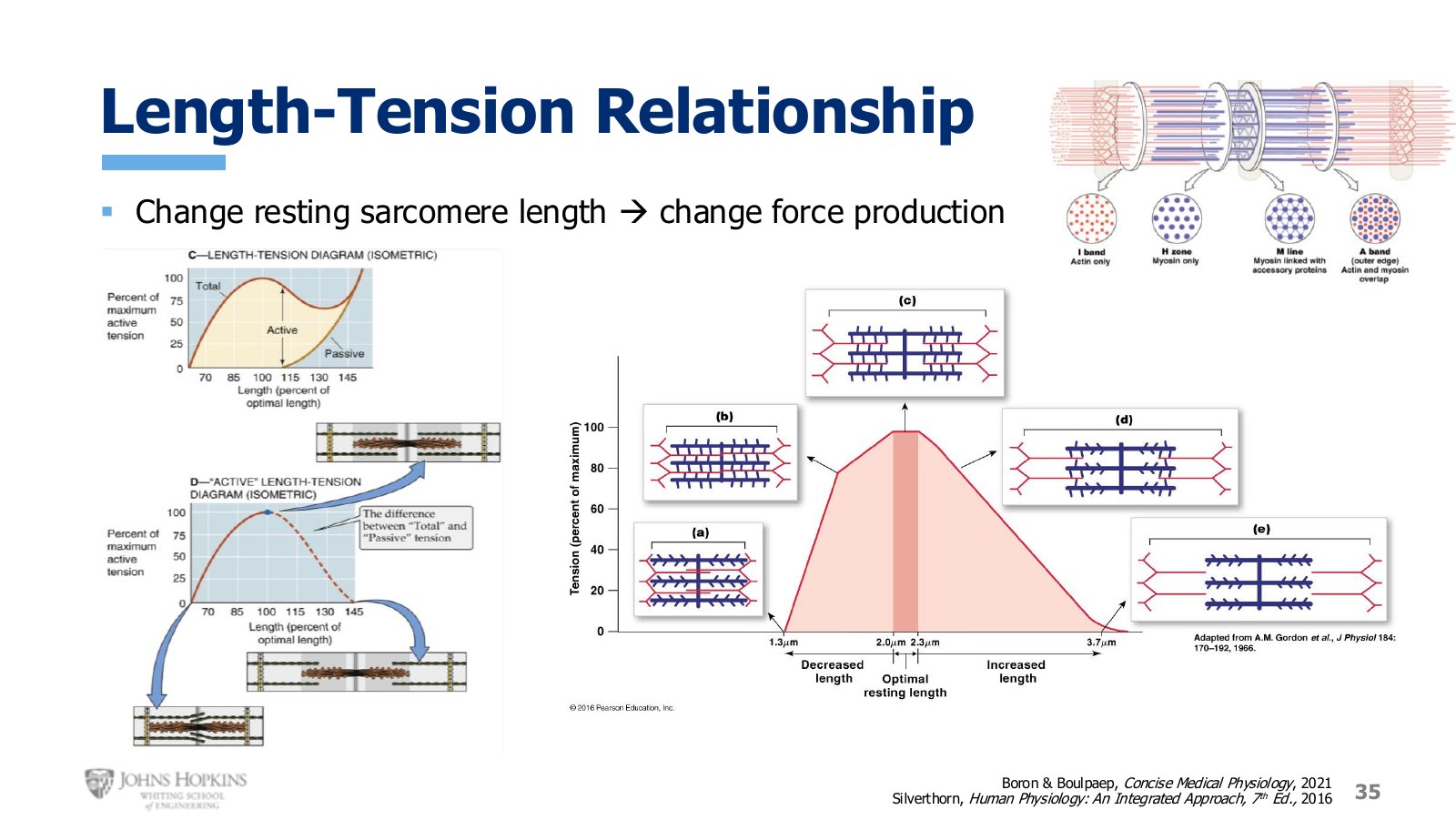
Slide 35. Force against resting sarcomere length, with the filament geometry at each point on the curve.
Change the resting length of a sarcomere and you change the overlap of thick and thin filaments, so when the muscle is stimulated you change the number of active cross-bridges and the resulting force.
The classic graph plots resting sarcomere length on the x-axis against force produced during contraction on the y-axis, and it forms a bell curve. Too short or too long and the sarcomere cannot produce much force. There is a sweet spot in the middle where force is optimized.
Very long resting lengths. Thick and thin filaments do not overlap enough to produce many cross-bridges, if any, so very little force is produced.
Very short resting lengths. The intricate spatial alignment gets disrupted. At point B the thin filaments have collided with the M line. At point A the M line collision has worsened and the thick filaments have crashed into the Z disc at the end of the sarcomere. The precise spatial relationships are obliterated when the filaments are crunched against the Z and M lines.
The middle. Overlap is maximized, and with it the number of potential cross-bridges, without compromising the spatial arrangement.
2. Frequency of stimulation
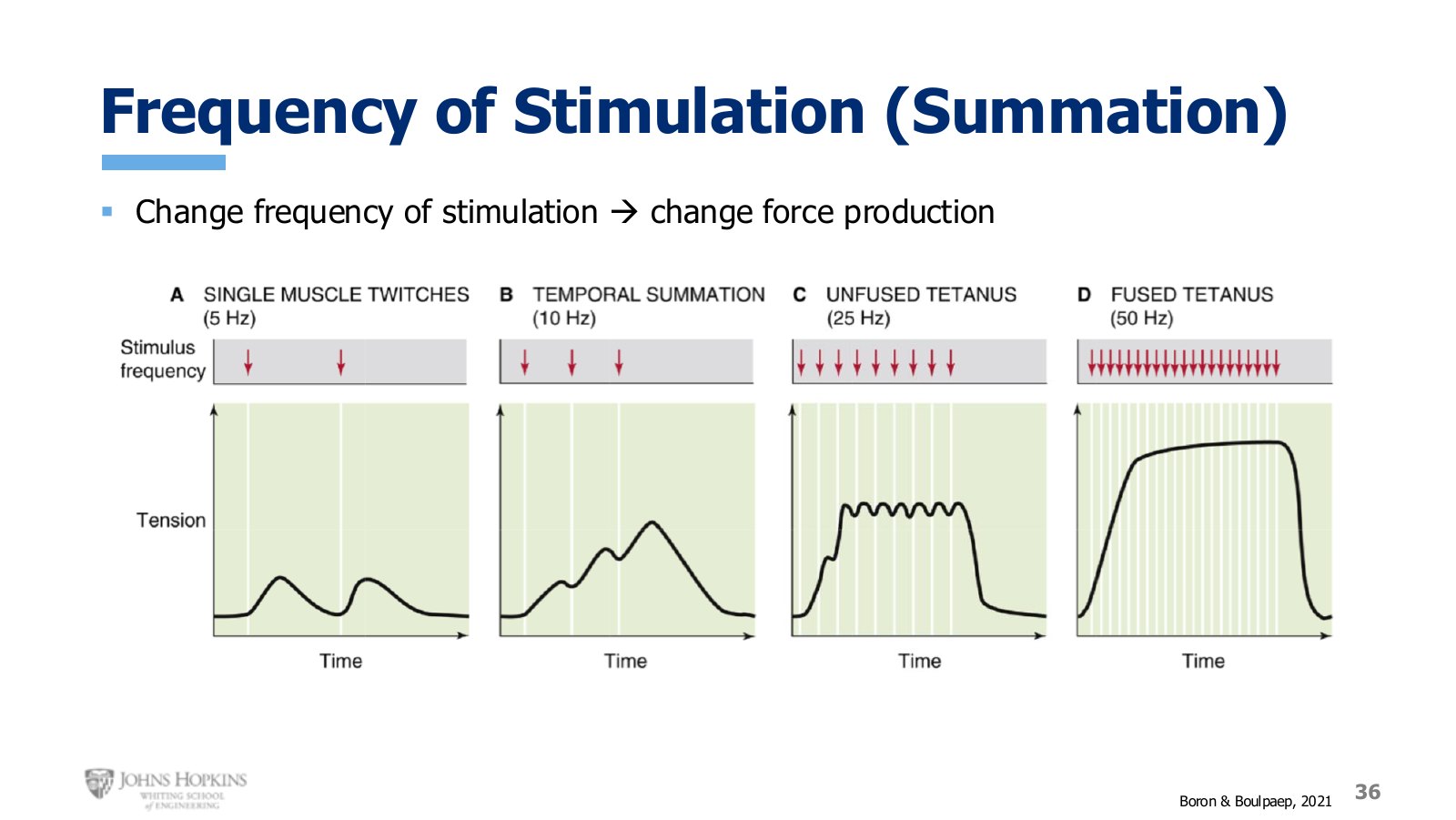
Slide 36. Twitches at 5, 10, 25, and 50 Hz. The waveform climbs and then smooths out.
Stimulate a muscle cell twice with the stimuli spaced far enough apart and the first twitch completely relaxes before the next begins. Two similar, separate twitches.
Move from 5 Hz to 10 Hz and the second stimulus arrives before the first twitch has fully relaxed, and the third before the second has. Each contraction piggybacks on the previous one, raising baseline tension each time. This force summation is very similar to the temporal summation covered for graded potentials in Module 2.
At 25 Hz the response levels off into a steady state. The peak of each individual twitch is still visible, because a little relaxation still occurs before the next contraction, but the peaks sit very close together. This sustained high tension is unfused tetanus. Tetanus refers to the sustained high-level tension; unfused refers to the individual twitch peaks still being discernible.
At 50 Hz the waveform is smooth. Individual twitches do not even begin to relax before the next hits, so the bumpy appearance disappears. This maximal sustained contraction is fused tetanus, because you can no longer tell where one contraction ends and the next begins.
3. Motor unit recruitment
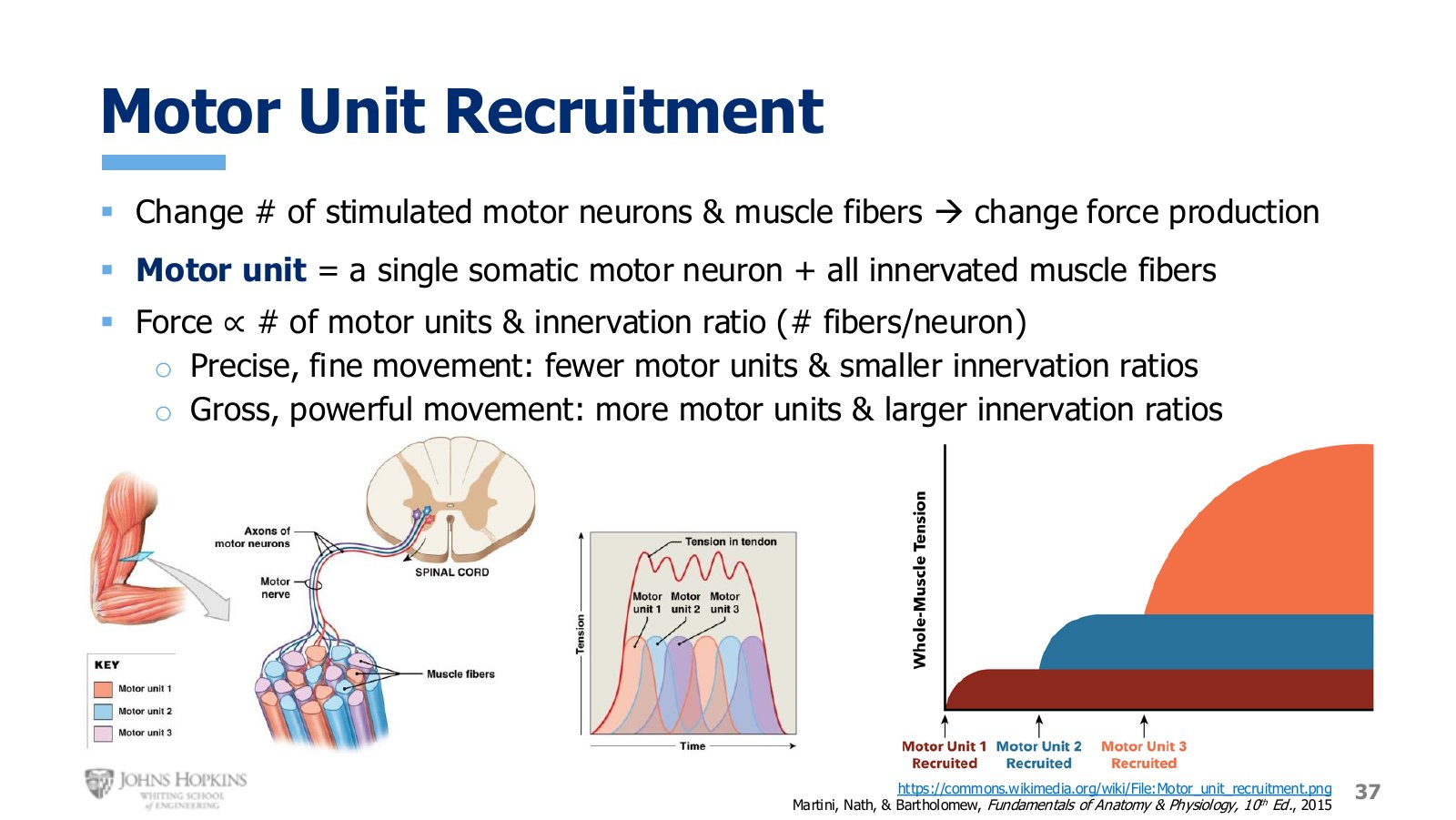
Slide 37. Three color-coded motor units, and the staircase of force as each is added.
A motor unit is a single somatic motor neuron and all the muscle fibers it branches out to innervate. Some motor neurons branch only a little, innervating say ten fibers; others branch extensively to innervate hundreds.
Recruiting motor units in a staggered sequence sustains a given level of force for a given time without fatiguing the fibers. One unit activates and then rests while the others take their turns.
Recruiting them simultaneously changes the magnitude of force. Motor unit 1 alone gives a small increase. Adding unit 2 while still stimulating unit 1 increases the number of contracting fibers and total force. Adding unit 3 increases it again.
So force production is proportional to the number of motor units stimulated and to the innervation ratio, the number of muscle fibers innervated by each somatic motor neuron. Fine movements that prioritize precision recruit fewer motor units with smaller innervation ratios. Larger movements requiring power recruit more motor units with larger innervation ratios.
The size principle
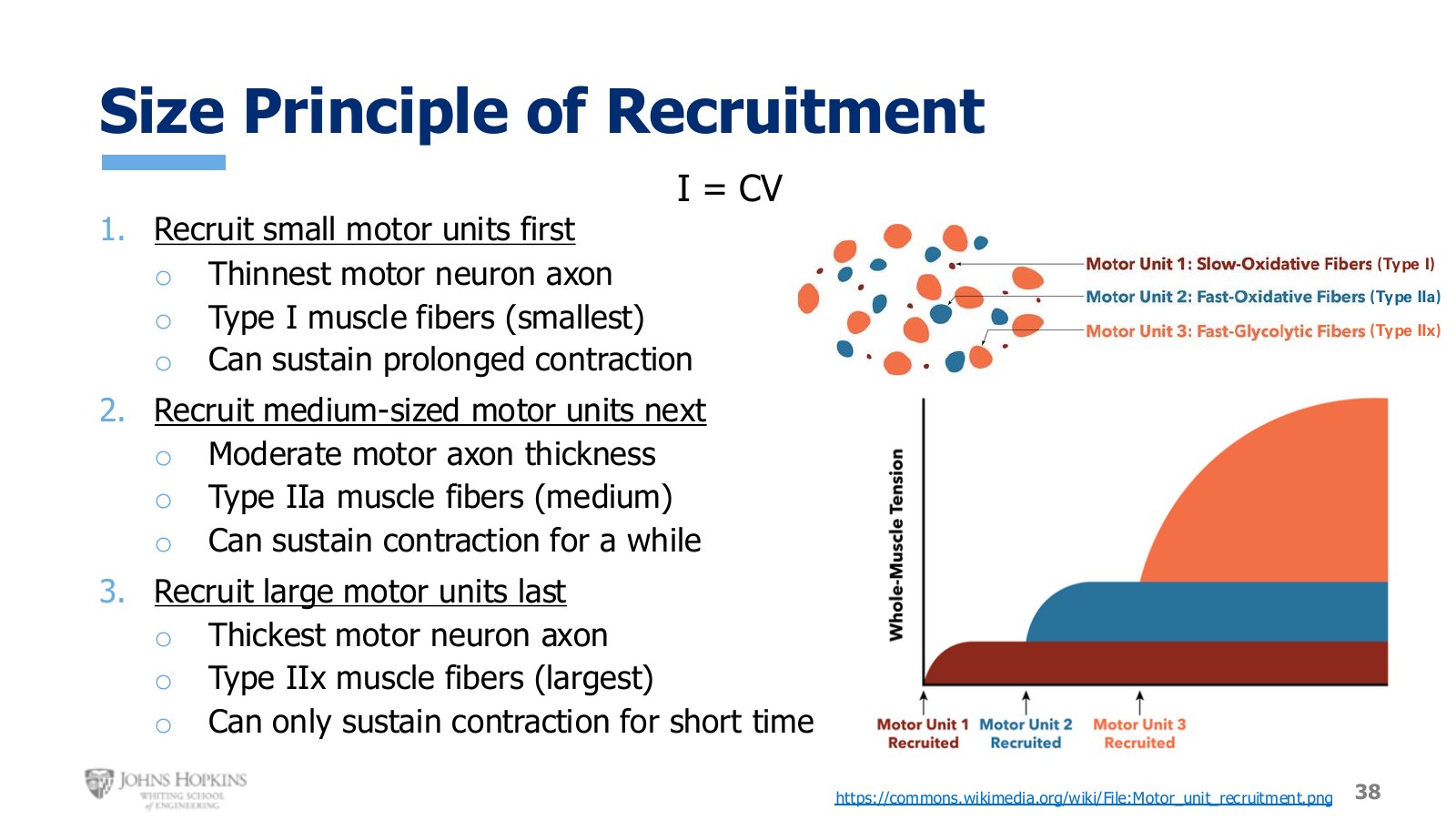
Slide 38. Recruitment order, from thinnest and most fatigue resistant to thickest and fastest fatiguing.
The size principle of recruitment says which motor units get recruited first, next, and last. The body recruits the smallest motor units first: thinnest motor neuron axons, innervating the thinnest Type I fibers.
Part of the reason is fatigue resistance. Type I fibers can sustain contraction for a very long time. But there is also an electrical reason, from the relationship current = capacitance × voltage.
The voltage term stays constant across motor units, since the voltage change required to depolarize a neuron or muscle cell is the same for all of them. Capacitance is the variable. Module 2 established that the cell membrane acts as a capacitor, and smaller neurons and muscle cells have less membrane surface area, so their capacitance is lower. Lower capacitance means the current, the ion flow, required to achieve the necessary voltage change is also lower. Stated plainly, it is simply easier to depolarize the thinnest neurons and muscle cells, so they are recruited first.
Recruitment order
Order | Axon | Fiber type | Sustains contraction |
|---|---|---|---|
1st | Thinnest | Type I, smallest, slow oxidative, low force | For a very long time |
2nd | Moderate | Type IIa, medium, fast oxidative, medium force | For a while |
3rd | Thickest | Type IIx, largest, fast glycolytic, high force | Only a short time |
The largest motor units have the highest membrane capacitance and are the most difficult to depolarize. There is a reason we do not recruit them unless we absolutely have to, and they can only sustain contraction briefly, so they are held off until closer to the end.