3F · Dynamics of Skeletal Muscle Contraction
So far only the increase in force has mattered. Now the changes in muscle length during a contraction matter too. All muscle contractions are categorized by how their length changes over the course of a contraction.
Isotonic concentric
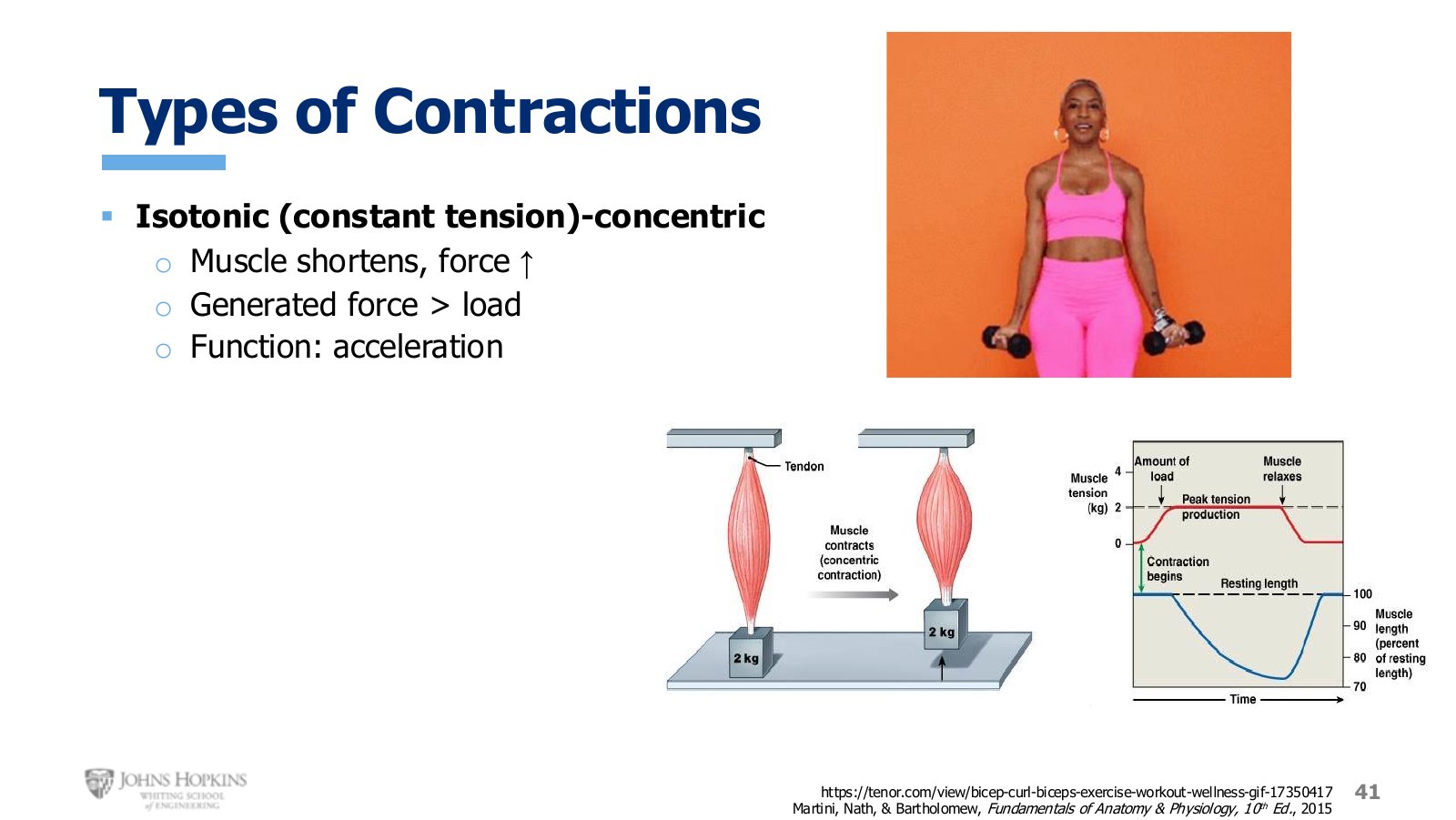
Slide 41. Concentric: muscle shortens, force exceeds load, function is acceleration.
Isotonic means the tension the muscle produces reaches a plateau and stays constant. Concentric means the muscle shortens during contraction. At the microscopic level the sarcomere shortens; at the macroscopic level the entire muscle shortens.
A bicep curl is the example. The biceps brachii is attached at the forearm bones near the elbow and anchored at the shoulder. When it contracts the muscle shortens, bending the elbow. For the muscle to shorten, the force it produces must be greater than the load. Attach a 2 kg weight and the muscle contracts with just a smidge more than 2 kg of force, lifting the weight and shortening in the process. Force rises and plateaus at just enough to lift the weight, while muscle length decreases. Concentric contractions play an acceleratory role.
Isotonic eccentric
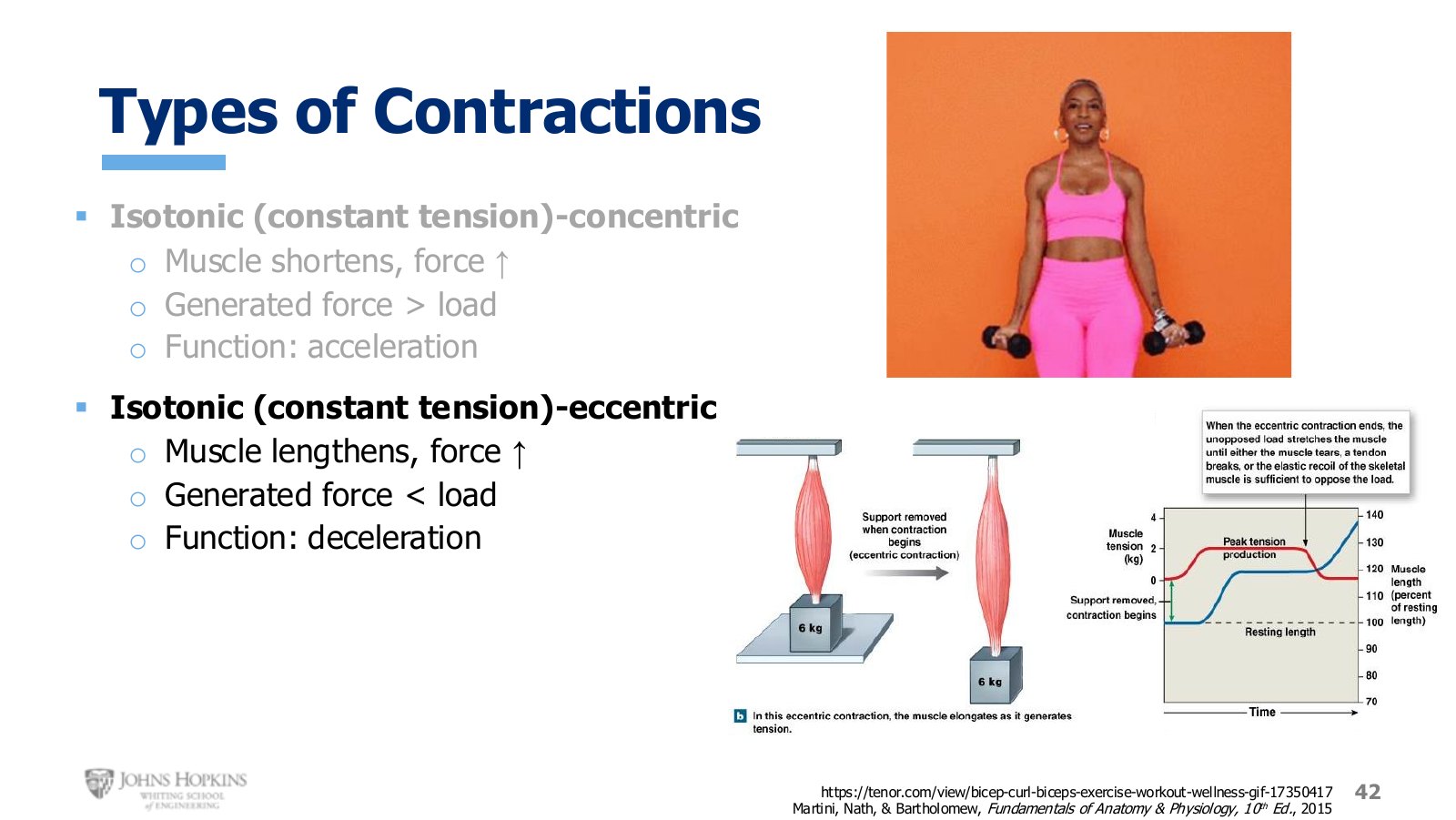
Slide 42. Eccentric added: muscle lengthens, force is less than load, function is deceleration.
The muscle still generates a constant level of tension, but it does so as the muscle lengthens. In the bicep curl, this is the phase where the weight gets lowered back down in a controlled manner. Tension is less than the load, which is why the load wins and pulls the muscle longer.
Attach a 6 kg weight to a muscle generating 2 kg of force, then take away the platform. Force rises to its level and plateaus, the isotonic part, and muscle length increases from baseline up to 120% of baseline length. We experience eccentric contractions constantly, in pretty much every movement we make, and they function in a deceleratory role, giving a controlled slowdown.
Isometric
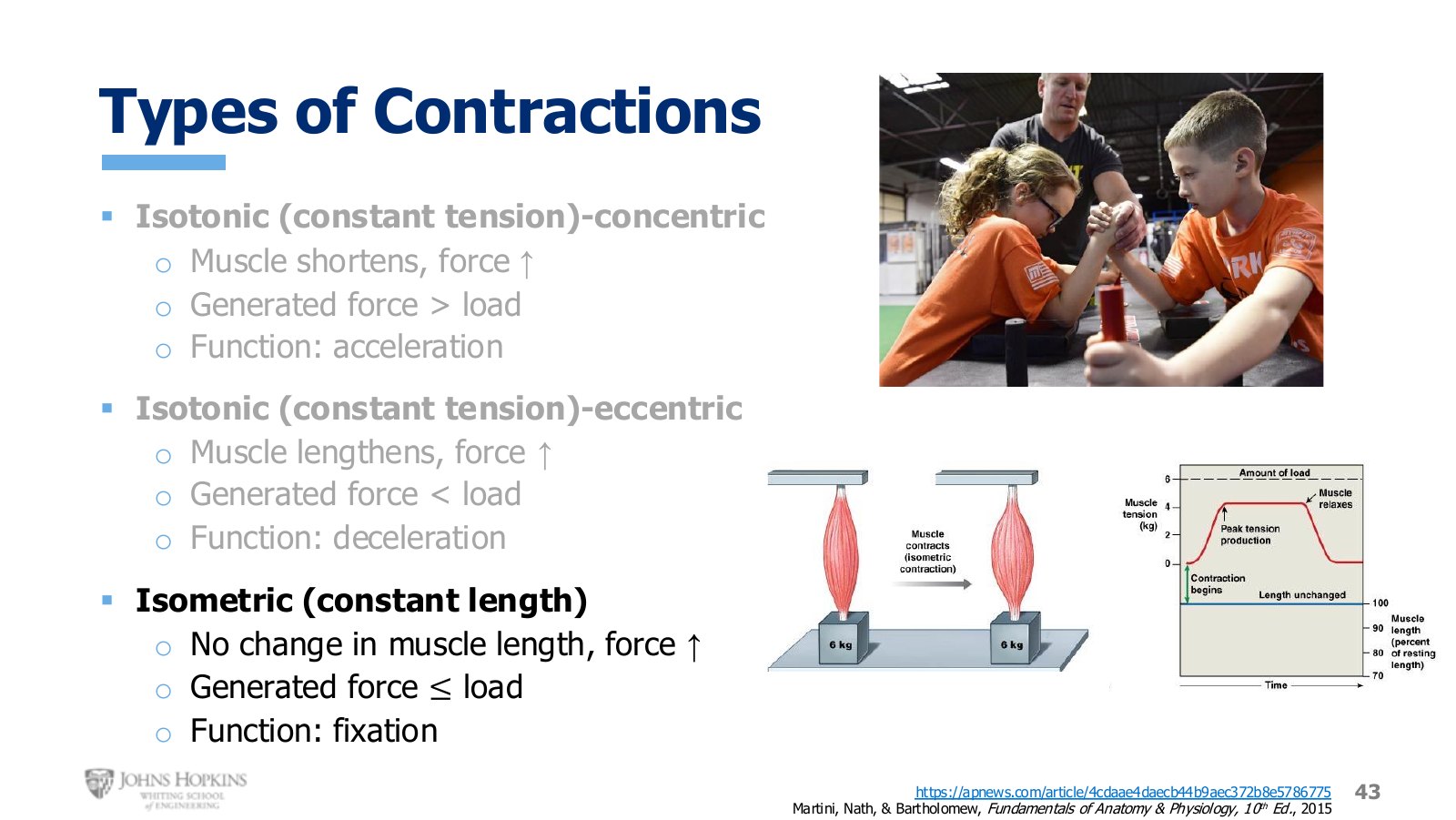
Slide 43. All three together. Isometric: length unchanged, force at or below load, function is fixation.
Isometric literally means same length. The muscle still produces force but its length does not change, because the force generated is the same as or less than the load.
Picture trying to lift a barbell that is far too heavy to budge. Lots of force generation, no change in length at all. On the slide, a muscle needs to lift 6 kg but can only generate 4 kg, so it produces 4 kg of tension and length does not change. Being deadlocked in arm wrestling, perfectly matched against your opponent, is the same thing with load equal to tension. So is carrying a bag of groceries from one place to another, holding your arm steady and stable with no movement as you go.
The functional purpose is fixation and stability. Any time you stand still, your postural muscles are isometrically contracted to fight gravity and keep you from collapsing onto the floor.
Load, shortening, and time
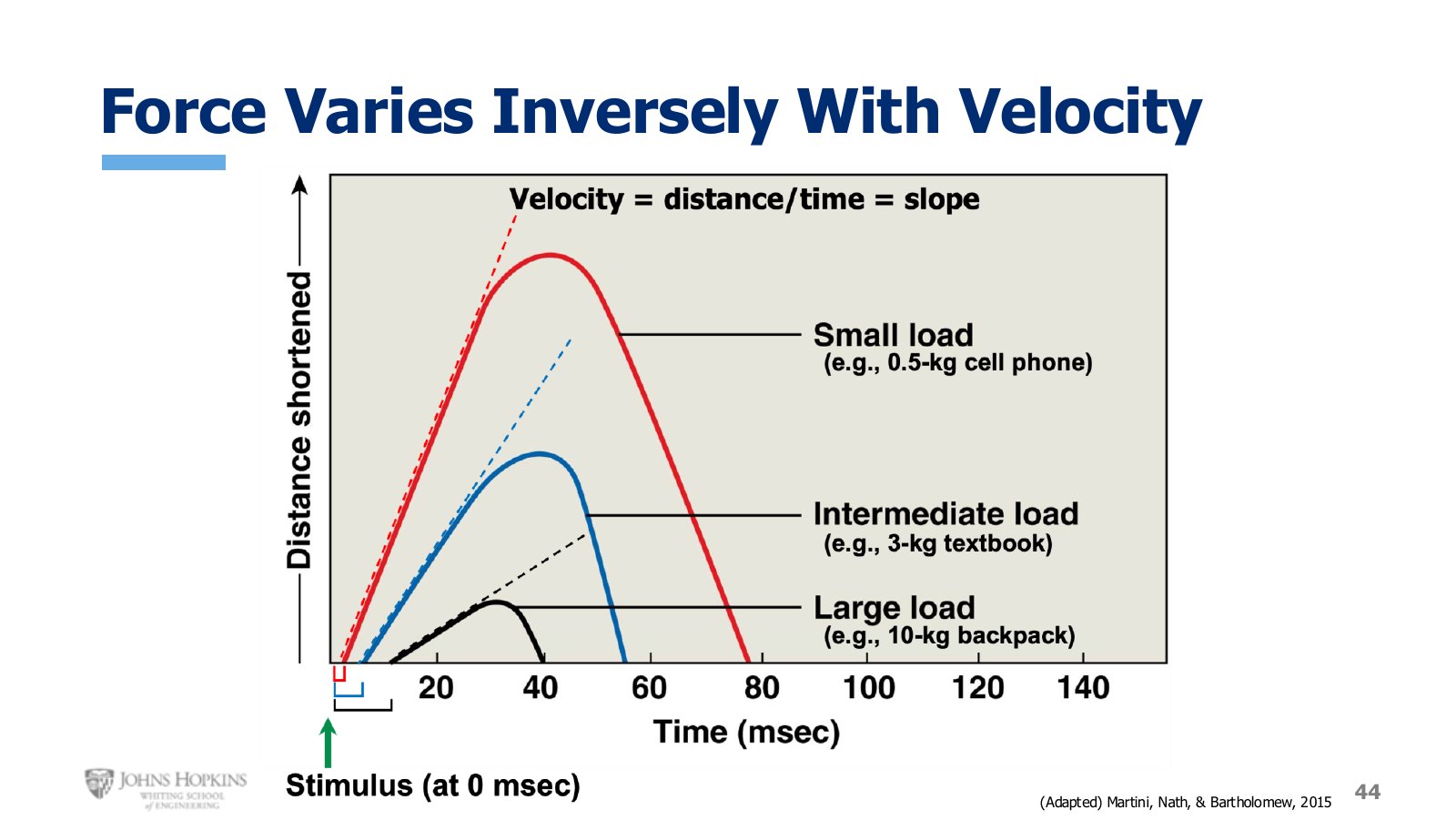
Slide 44. Three loads, three shortening curves. Heavier loads shorten less, take less time, and spend longer isometric first.
Plot how much a muscle shortens over time during concentric contractions, with time on the x-axis and distance shortened on the y-axis.
Very light load, a half-kilogram cell phone. The muscle shortens a great deal, so the whole contraction and relaxation takes a fairly long time. More displacement takes more time.
Moderate load, a 3 kg textbook. Harder to move, so the muscle shortens less, and the whole cycle takes less time.
Very heavy load, a 10 kg backpack full of books. Barely shortens at all, so the cycle takes very little time.
All three receive the electrical stimulus at the same time, but they do not start shortening at the same time. Beyond the short latent period, which is the same for all three, each muscle first goes through some isometric contraction, spending time generating enough force to exceed the load before it can begin moving. The cell phone needs very little time to reach half a kilogram of force. The textbook needs more to reach 3 kg. The backpack needs the longest to reach 10 kg.
Velocity is distance divided by time, so the slope of each curve during the shortening phase gives shortening velocity. Comparing slopes: shortening velocity is high when the load is low, and low when the load is high.
The force-velocity curve
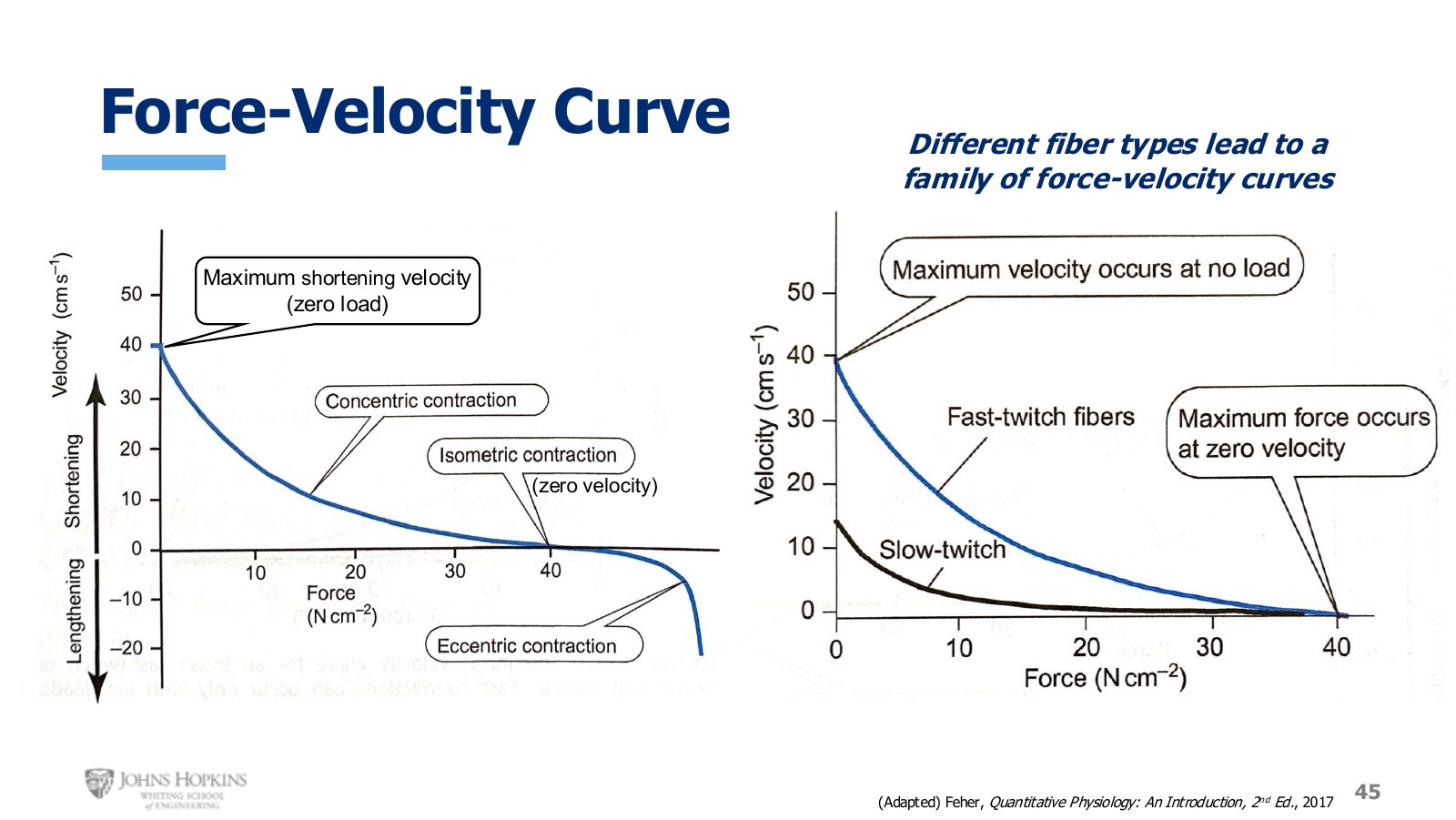
Slide 45. Force on the x-axis, velocity on the y-axis. Above zero is shortening, below is lengthening, and the crossing point is isometric.
Shortening velocity moves up from zero on the y-axis, and lengthening velocity moves down from zero. So any part of the curve above the zero line is muscle shortening, a concentric contraction. Any part below is muscle lengthening, an eccentric contraction. Where the curve crosses zero, shortening velocity is zero and the muscle is not changing length at all, an isometric contraction.
The curve reinforces the previous slide. As the load increases, force production increases, and as force production increases, the velocity of shortening slows toward zero.
There is a whole family of these curves, shifting up or down depending on the fiber type. Fast-twitch fibers have faster shortening velocity and produce stronger contractions, so their curve sits higher than the less forceful slow-twitch curve.
Muscle power
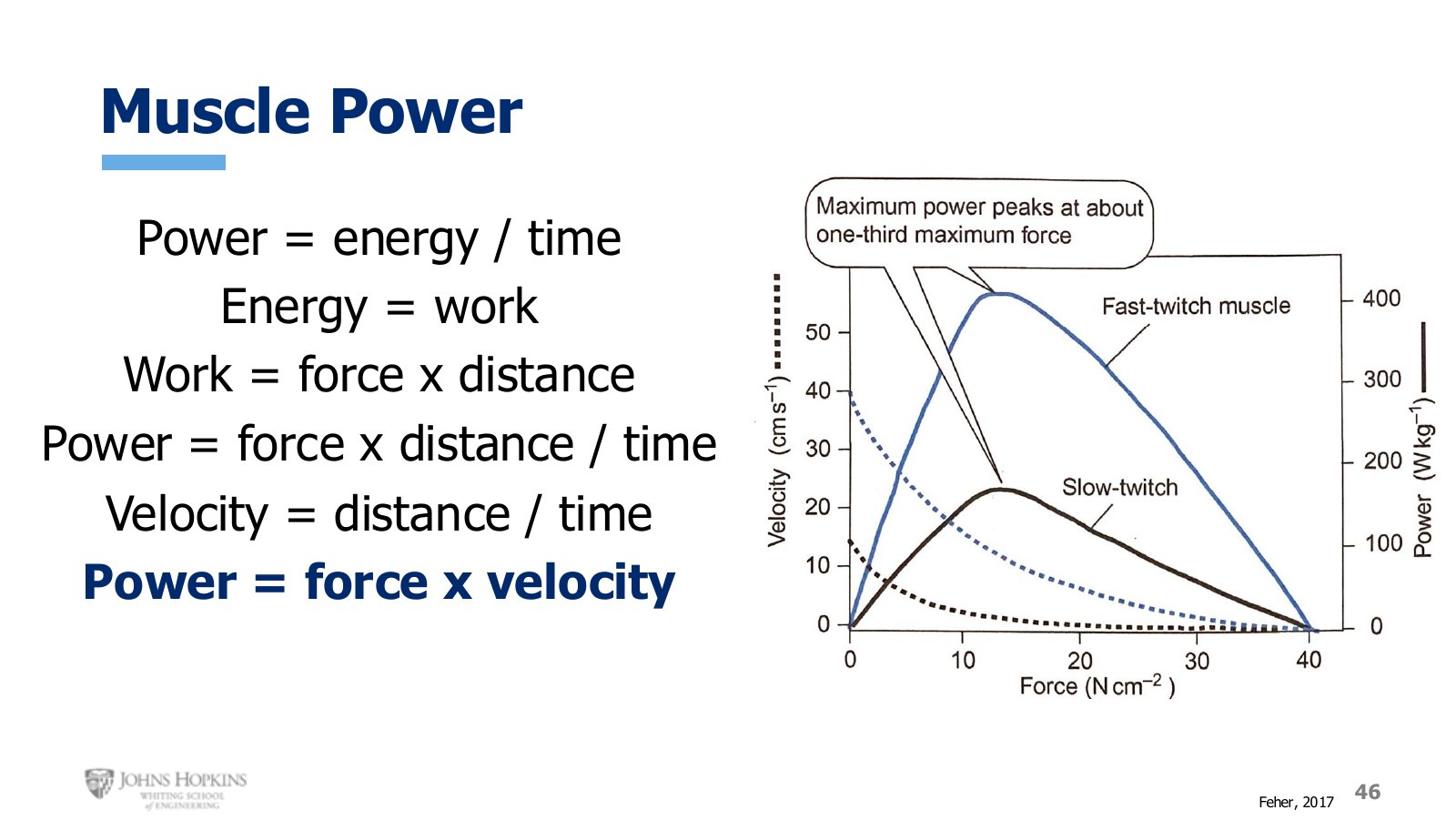
Slide 46. Power curves superimposed on the force-velocity curves for fast and slow twitch muscle.
Power is energy divided by time. Energy can be equated to work, and work is force times distance.
Superimpose power curves onto the force-velocity curves and two things show up. Power peaks at about one third of maximum force. And fast-twitch muscles are indeed more powerful than slow twitch, producing roughly two to three times more power than their slow-twitch counterparts.