8B · Vascular Hemodynamics: An Overview
Vascular hemodynamics is fluid dynamics applied specifically to blood in the vasculature. Four major equations govern and model the behavior of the blood vessels.
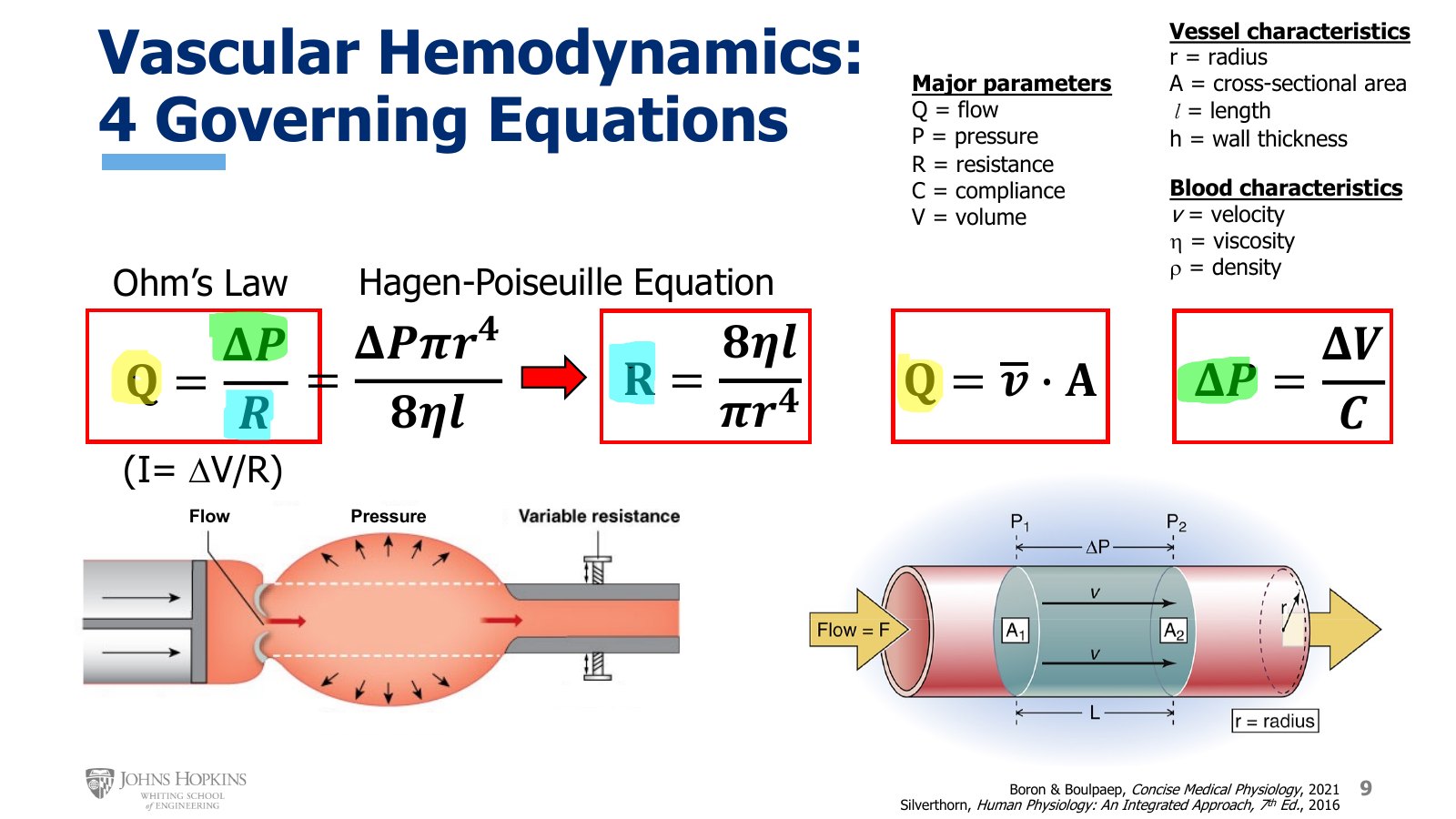
Slide 9. The four governing equations, with the variable key at top right. Bottom left, flow in, pressure in the vessel, and a variable resistance on the way out. Bottom right, flow through a tube of radius r between two pressures.
Equation 1: Ohm’s law
The fluid dynamics version of Ohm’s law says flow, Q, equals the change in pressure across the circulation from beginning to end, divided by the resistance across the circulation. Each term has an electrical counterpart:
Q, the flow of blood, is analogous to I, current, the flow of electrons.
ΔP, the change in pressure from the beginning of the circulation (the systemic circulation, say) to the end, is analogous to the change in voltage from the start of the circuit to the end.
R, resistance to the flow of blood, is analogous to resistance to the flow of electrons.
This equation is perhaps the most fundamental underlying principle that predicts and models fluid dynamics in the circulation. Visually, the volume of blood in the vessel is determined by the balance between inflow, or just plain flow, and outflow, which is determined by resistance. As vessel volume increases, vessel pressure increases along with it.
Equation 2: Hagen-Poiseuille, and resistance
A German engineer named Hagen and a French physicist and physiologist named Poiseuille independently figured out that Ohm’s law could be refined to incorporate some variable characteristics of the tube and the fluid. That gives the Hagen-Poiseuille equation: flow equals the change in pressure across the fluid circuit, times pi, times the radius of the tube raised to the fourth power, all divided by 8 times the viscosity of the fluid times the length of the tube.
Rearrange it a little and you get the next major governing equation. Vascular resistance equals 8 times blood viscosity times vessel length, divided by pi times vessel radius raised to the fourth power.
This shows that characteristics of the vessels and of the blood can quantifiably contribute to resistance, the opposition to blood flow through vessels.
Equation 3: flow from velocity and area
A different way of framing flow: flow equals the mean velocity of flow through a vessel times the cross-sectional area of the vessel.
Equation 4: compliance
The fourth equation defines vascular compliance in terms of pressure. The change in pressure experienced by the vessel equals the change in volume experienced in the vessel divided by the vessel’s compliance. This is a rearrangement of the more traditional compliance equation.
Variables to keep track of
These equations help us understand and model flow, resistance, and pressure, and there are a lot of variables. We will study the major cardiovascular parameters, and also keep in mind characteristics of the vessels and of the blood that flows through them.
The variable key
Group | Symbol | Meaning |
|---|---|---|
Major parameters | Q | Flow |
Major parameters | P | Pressure |
Major parameters | R | Resistance |
Major parameters | C | Compliance |
Major parameters | V | Volume |
Vessel characteristics | r | Radius |
Vessel characteristics | A | Cross-sectional area |
Vessel characteristics | l | Length |
Vessel characteristics | h | Wall thickness |
Blood characteristics | v | Velocity |
Blood characteristics | η | Viscosity |
Blood characteristics | ρ | Density |
Pressure, flow, and resistance
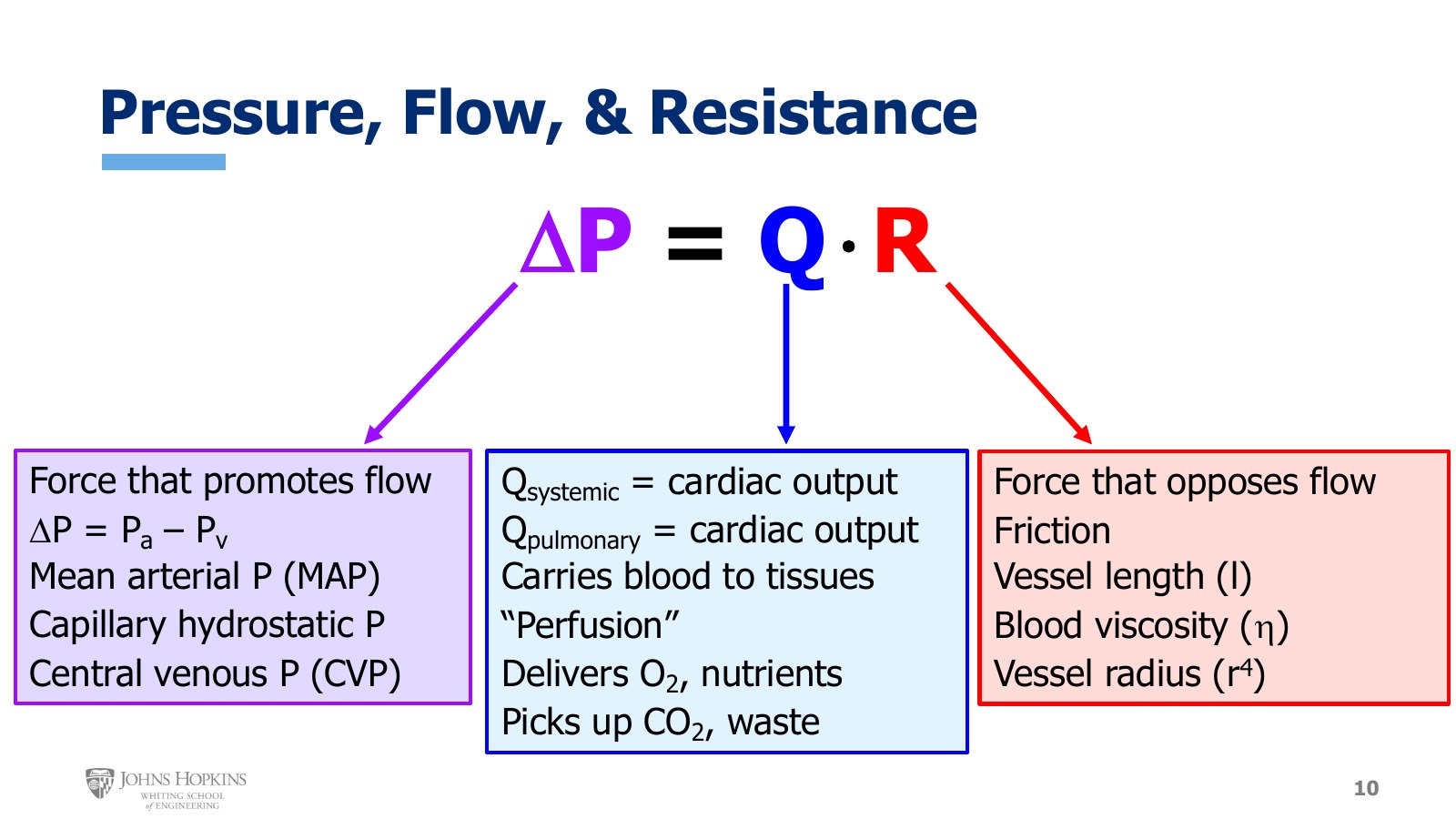
Slide 10. Ohm’s law rearranged as ΔP = Q · R, with what each term means in the vasculature.
Pressure, flow, and resistance will matter in every discussion that follows, so here they get a more vascular definition and context. Rearranging Ohm’s law:
ΔP. In its broadest sense, the force that promotes flow of blood through the circulation. We typically define it as the pressure at some point early in the circulation minus the pressure at some point later on downstream. For the circulation as a whole, either systemic or pulmonary, that means arterial pressure upstream, early in the path, minus venous pressure farther downstream, later in the path.
Even arterial pressure and venous pressure are fairly general terms. This module refines them, focusing on the systemic circulation and three specific vascular pressures from different points in it: mean arterial pressure, capillary hydrostatic pressure, and central venous pressure.
R. In its broadest sense, the force that opposes the flow of blood through the circulation, primarily because of friction within the vessel. Vascular resistance is quite literally a resistance to the forward flow of blood. Adjustments that make forward flow easier do so by reducing resistance. Anything that makes flow more difficult does so by increasing resistance. As the rearranged Hagen-Poiseuille equation showed, the major physiological factors affecting resistance are vessel length, blood viscosity, and vessel radius.
Q. The flow of blood is what brings blood to the tissues of the body. Flow through the systemic circulation is simply cardiac output as it comes out of the left ventricle. Flow through the pulmonary circulation is also cardiac output, as it comes out of the right ventricle. Flow rates out of both sides of the heart need to be equal for the heart to be in equilibrium.
Flow to various organs is often described with the word perfusion, as in brain perfusion, liver perfusion, or kidney perfusion. It describes how well supplied with flow a particular organ or tissue is. Flow has two major purposes:
Deliver oxygenated blood and nutrients through the arteries to the capillaries, for transfer into the cells and tissues of the body.
Pick up carbon dioxide and metabolic waste molecules from the tissues into the capillaries, and transport that blood through the veins to get reoxygenated, cleaned, and resupplied for another round of circulation.
The next lectures zoom in on each of these variables in turn: pressure in 8D, flow in 8E, and resistance in 8F.