4C · Modulation of Smooth Muscle Contraction and Relaxation
Every route below runs through G protein-coupled receptors triggering changes in second messenger production. Extracellular ligands binding receptors are what drive these changes in force.
More force: raise MLCK, lower MLCP
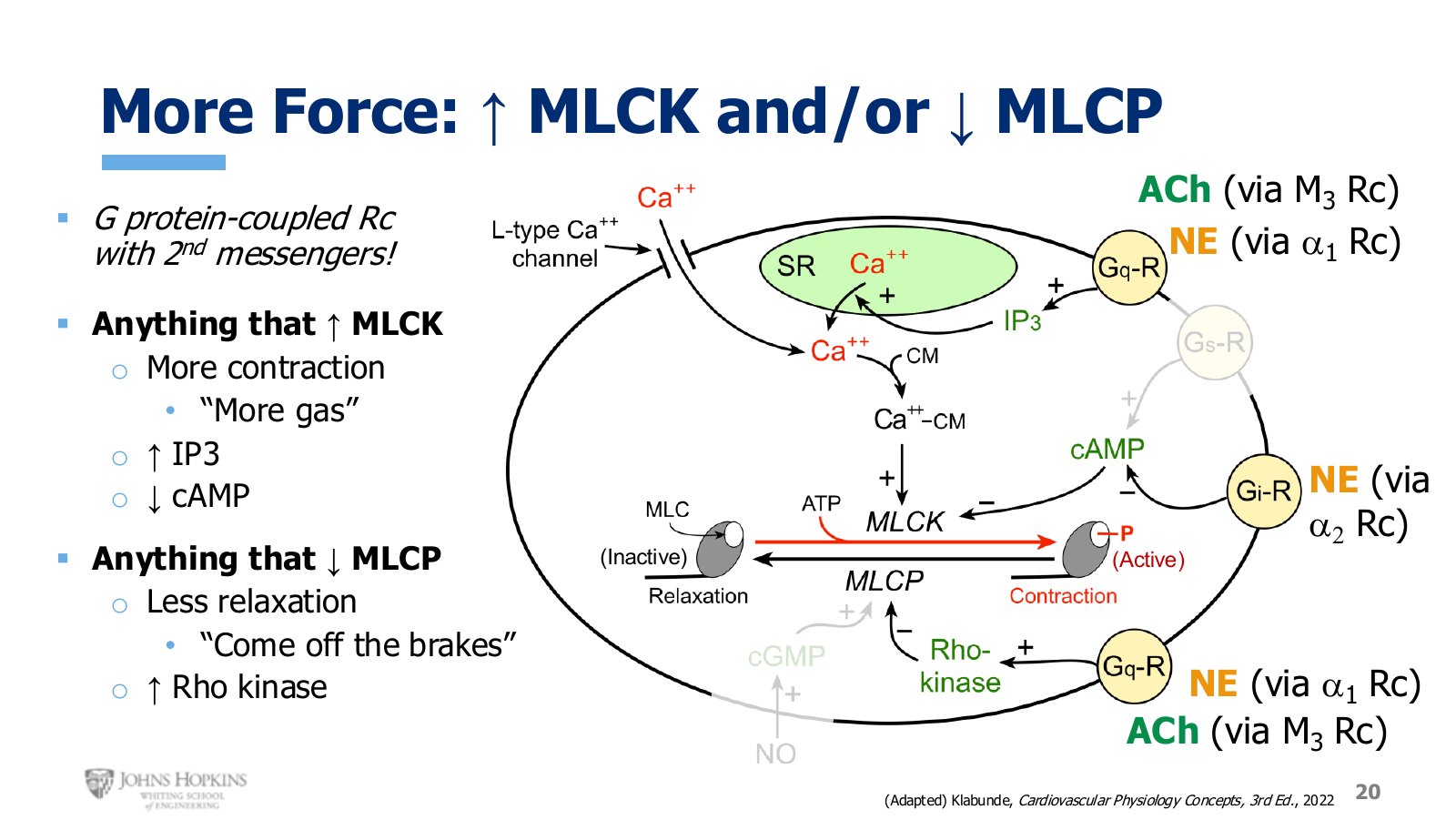
Slide 20. Three routes to more force, and the ligands and receptor subtypes that take each one.
Raise IP3. IP3 unlocks calcium release from the sarcoplasmic reticulum, so more IP3 means more calcium release and more kinase activation. The G protein that raises IP3 is Gq.
Acetylcholine at the neuromuscular junction bound nicotinic receptors, which were acetylcholine-specific ligand-gated ion channels. There are also acetylcholine-specific G protein-coupled receptors, called muscarinic receptors. The M3 subtype uses Gq and is found in respiratory smooth muscle.
Norepinephrine binds several receptor types, including alpha and beta receptors. The alpha-1 subtype uses Gq and is found in vascular smooth muscle in many blood vessels.
Lower cyclic AMP. Cyclic AMP inhibits MLCK activity in smooth muscle, so anything inhibiting cyclic AMP boosts MLCK. Receptors using Gi proteins, i for inhibitory, inhibit cyclic AMP production. Norepinephrine through the alpha-2 receptor decreases cyclic AMP, raising MLCK activity.
Inhibit MLCP. Anything inhibiting the phosphatase minimizes opposition to the kinase, indirectly boosting force. Both acetylcholine and norepinephrine, again through Gq, boost an enzyme called rho kinase, which inhibits MLCP activity.
Less force: lower MLCK, raise MLCP
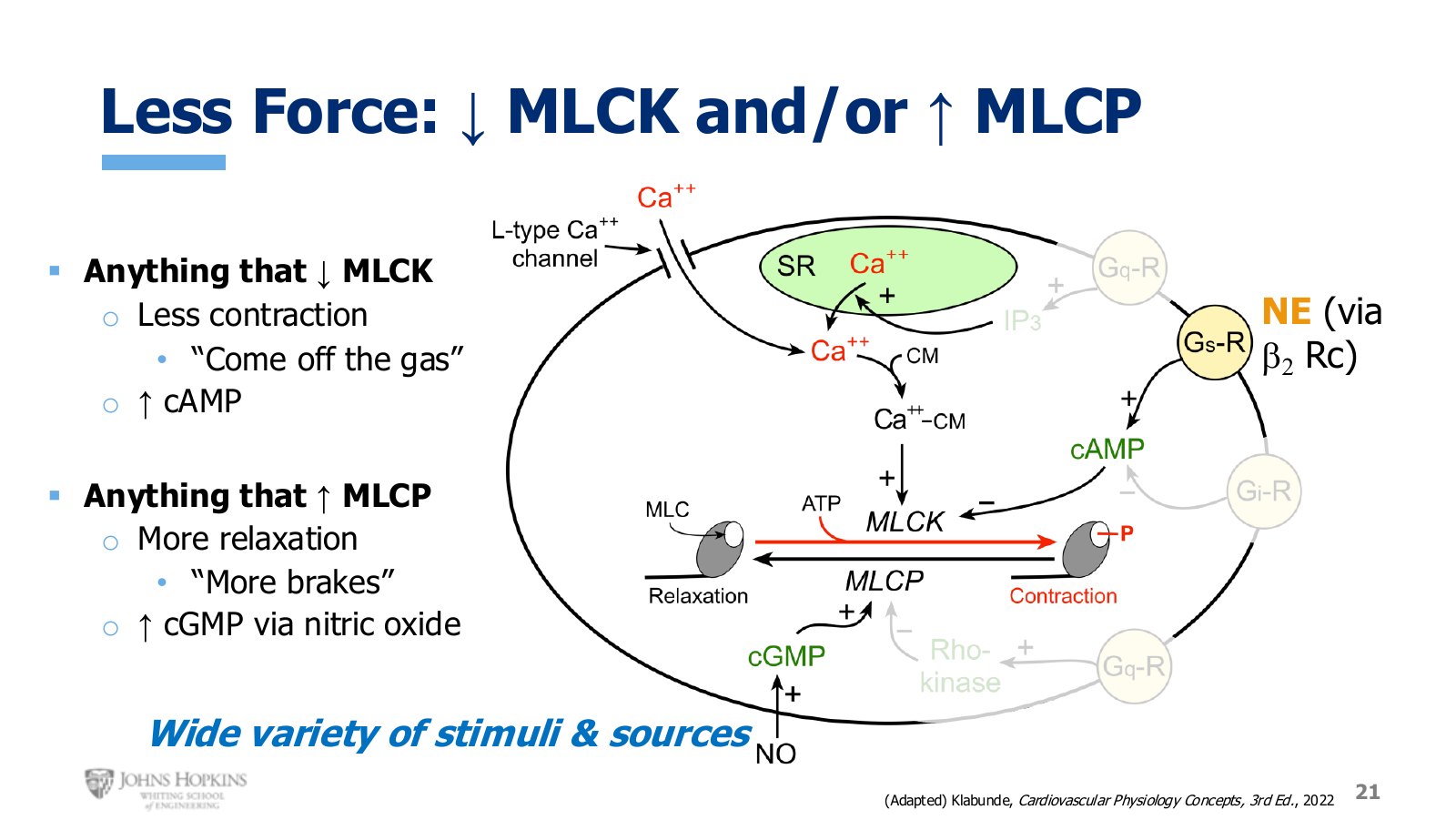
Slide 21. Two routes to less force. Nitric oxide is the one worth remembering.
Raise cyclic AMP. Since cyclic AMP is inhibitory on MLCK, raising it slows the kinase, which is coming off the gas pedal. Force declines simply because it is not being stimulated as much. The route is a receptor coupled to Gs, s for stimulatory, stimulating cyclic AMP production. Norepinephrine through its beta-2 receptor is coupled to Gs. In smooth muscle beta-2 receptors are mostly found in the vascular smooth muscle of blood vessels in skeletal muscle tissue.
Raise MLCP. Pressing harder on the brakes. The major route in smooth muscle is extracellular production of nitric oxide, which is hydrophobic and diffuses straight through the cell membrane. It increases production of the second messenger cyclic GMP, which raises MLCP activity and dephosphorylates more myosin.
Calcium sensitization and desensitization
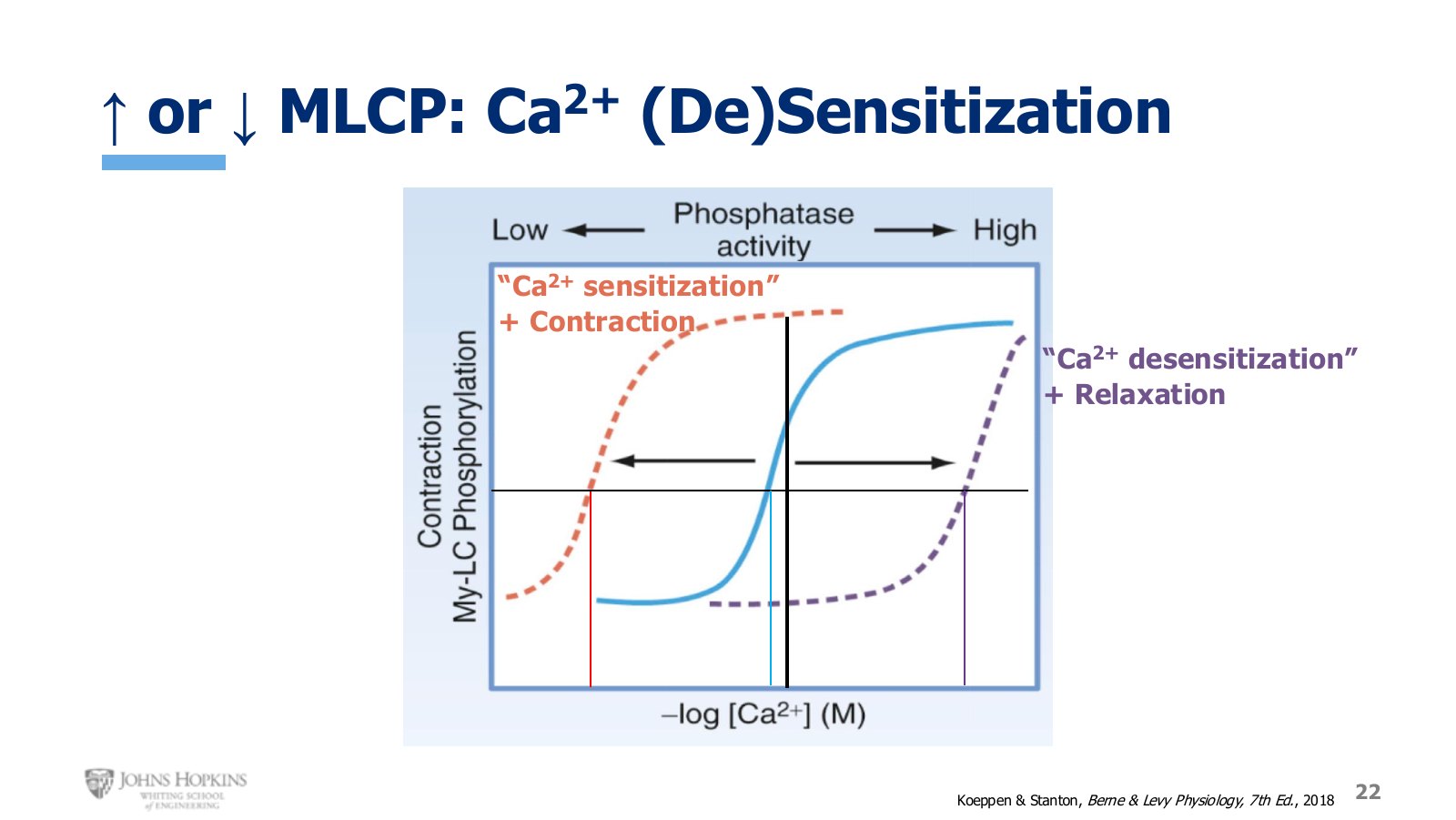
Slide 22. One sigmoid curve, shifted left or right. Same calcium, different contraction.
Changes in MLCP activity manifest as changes in calcium sensitivity. Plot intracellular calcium concentration against myosin phosphorylation and contraction, and the baseline is a sigmoid curve.
Shift right and a much greater calcium concentration is needed for the same contraction. This is calcium desensitization, which discourages contraction and promotes relaxation.
Shift left and much less calcium produces the same contraction. This is calcium sensitization, which promotes contraction.
MLCP activity is what induces the shift. High phosphatase activity reverses much of the kinase-driven phosphorylation, so a given amount of calcium produces little contraction. Low phosphatase activity leaves phosphorylation to proceed nearly unopposed, so the same calcium level produces much stronger contraction.