4F · Modulation of Cardiac Muscle Contraction and Relaxation
Cardiac muscle uses autonomic nerves, sympathetic and parasympathetic, to influence how the heart contracts.
Sympathetic stimulation, which is strong
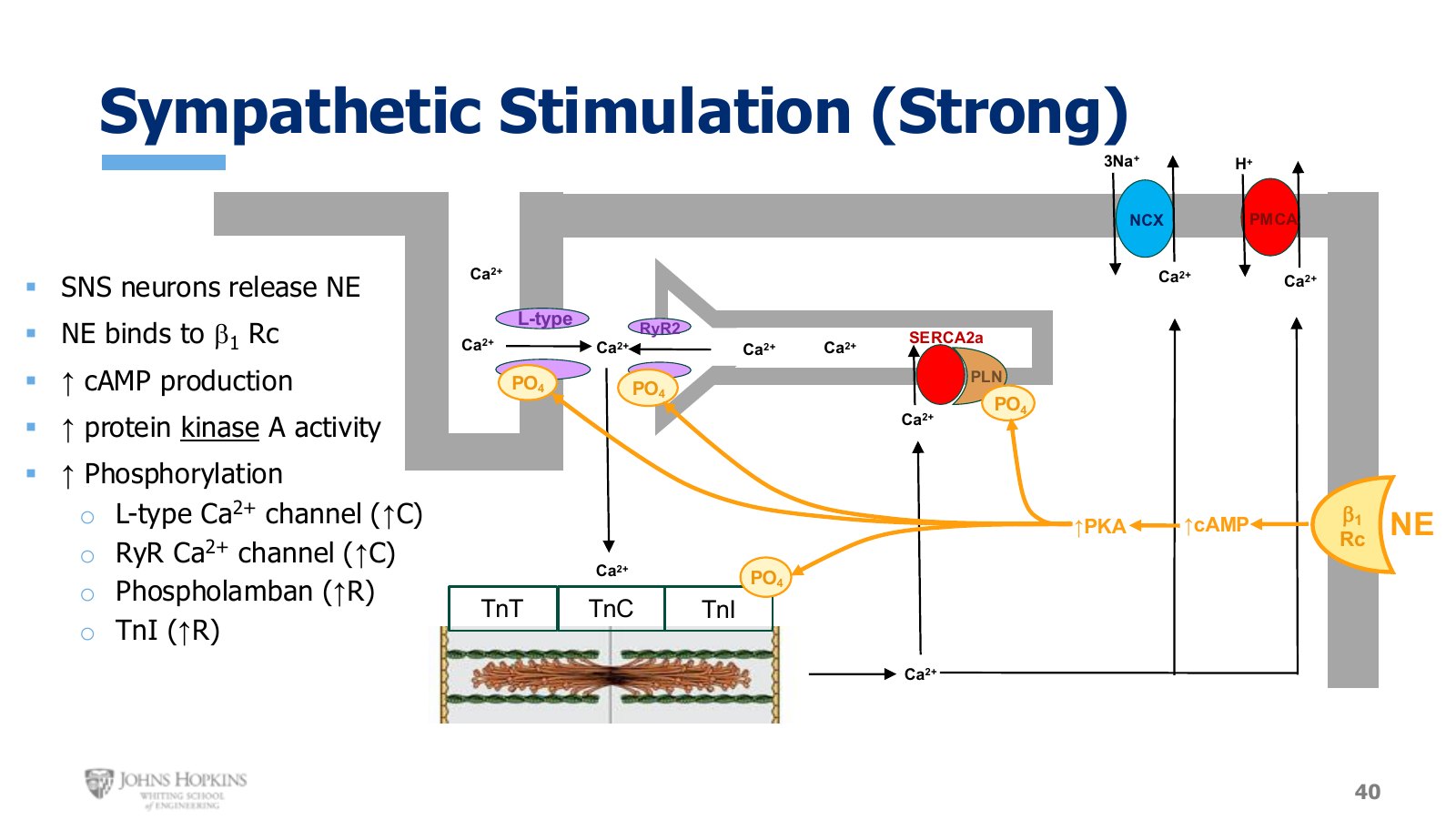
Slide 40. Norepinephrine to beta-1, cyclic AMP up, PKA up, and four targets phosphorylated. Two raise contraction, two speed relaxation.
Sympathetic nerves release norepinephrine, which binds beta-1 receptors on cardiac muscle. Norepinephrine has many receptors in the body falling into two major categories, alpha and beta, each with many subtypes. The major ones in the heart are beta-1.
Beta-1 receptors are G protein-coupled, so they change intracellular second messenger production. Stimulation raises cyclic AMP, which raises the activity of an enzyme called protein kinase A, or PKA. Being a kinase, PKA phosphorylates things, and it has four targets.
What PKA phosphorylates, and what it does
Target | Effect of phosphorylation | Result |
|---|---|---|
Voltage-gated calcium channel | Much higher probability of being open, so more calcium influx | Stronger contraction |
Ryanodine receptor | Much higher probability of being open, so more calcium release | Stronger contraction |
Phospholamban | Turns it off, freeing the SERCA pump | Faster, more complete relaxation |
Troponin I | Helps calcium dissociate from troponin C more easily and quickly | Faster, more complete relaxation |
Phospholamban acts as the brakes on the SERCA pump. More phospholamban activity slows the pump, slowing calcium reuptake and giving a slower, somewhat incomplete relaxation. Phosphorylating it turns it off, and without it slowing the pump, SERCA is free to move lots of calcium very quickly back into the sarcoplasmic reticulum.
Troponin I is the part of the troponin complex not yet discussed. The I stands for inhibitory. Phosphorylating it exerts an inhibitory influence on calcium binding to troponin C, helping calcium dissociate faster.
Parasympathetic stimulation, which is weak
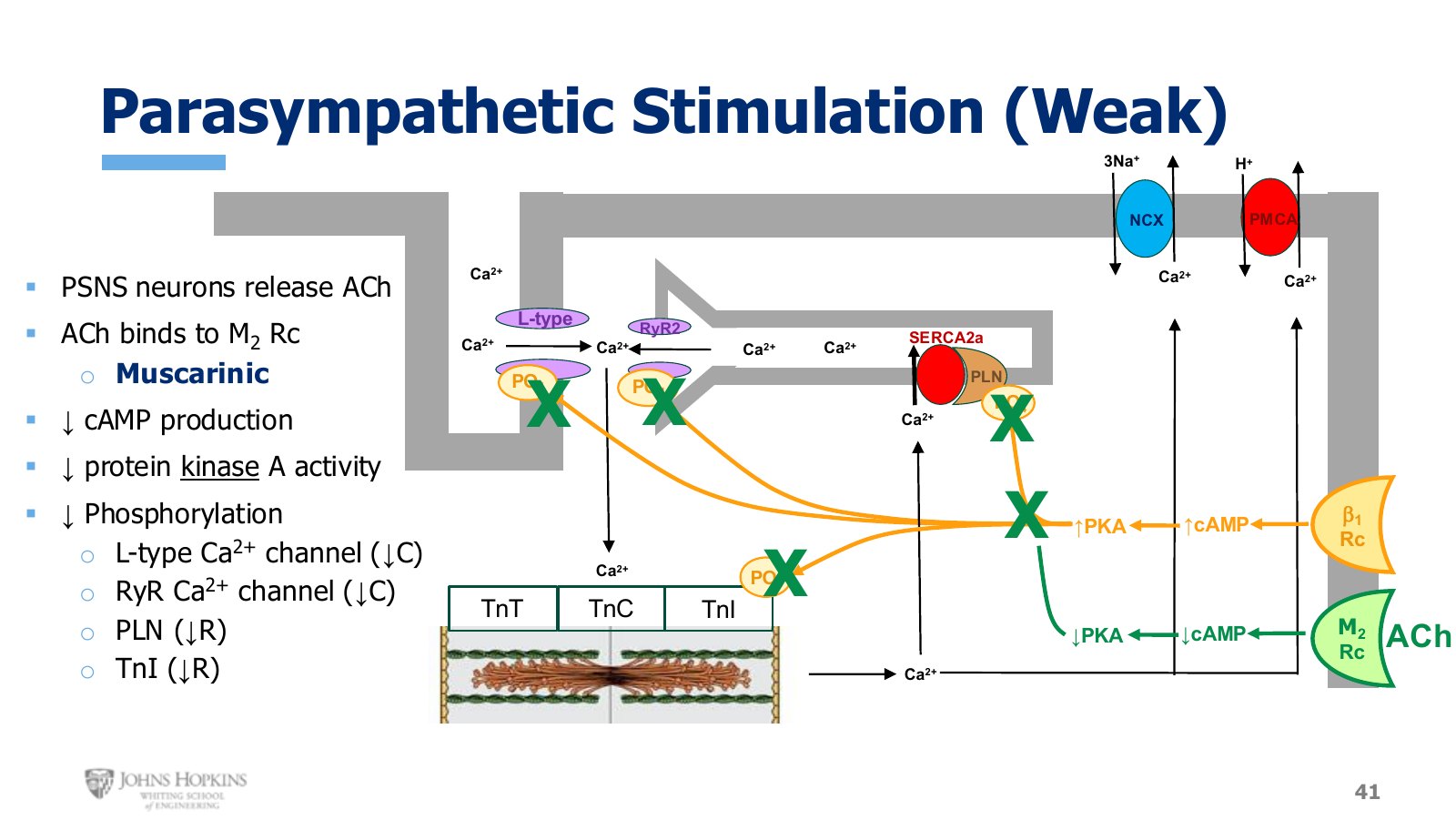
Slide 41. Acetylcholine to M₂, and every arrow on the previous slide reverses.
Parasympathetic nerves release acetylcholine, which binds muscarinic 2 receptors on cardiac muscle. Acetylcholine works through muscarinic receptors on smooth muscle too, though there it was the M3 subtype rather than M2.
M2 receptors are also G protein-coupled, and stimulation decreases cyclic AMP production.
These parasympathetic effects on cardiac muscle are quite weak, and the rest of the semester will not take them into account when discussing cardiovascular function in more detail.